Introduction
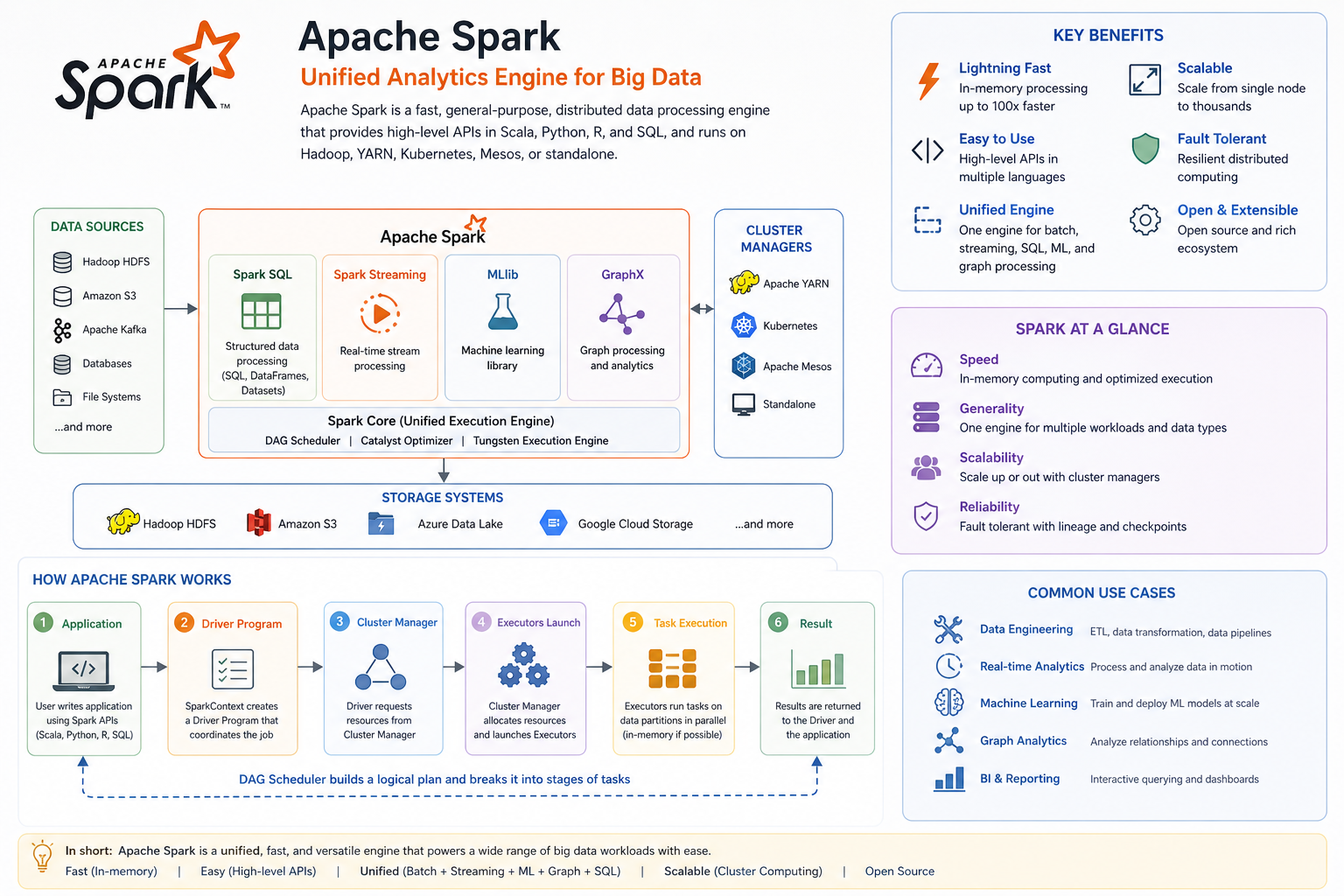
Apache Spark is an open-source unified analytics engine specifically designed for large-scale data processing. Hereafter, we will refer to it as Spark. This engine is renowned for its speed, flexibility, and ease of use, making it a preferred choice for handling extensive data sets. Spark is capable of performing operations on billions and trillions of data points using distributed clusters, achieving speeds up to 100 times faster than traditional applications.
Apache Spark is fundamentally a distributed computing system tailored for big data processing and analytics. Initially developed at the University of California, Berkeley's AMPLab, it was eventually contributed to the Apache Software Foundation, elevating it to a flagship Apache project.
Spark offers a robust, unified framework for diverse data processing tasks, including batch processing, real-time stream processing, machine learning, and graph analysis. Its design centers on speed and efficiency, especially by addressing the limitations of MapReduce through in-memory processing. This innovative approach allows Spark to reuse data efficiently with an in-memory cache, speeding up machine learning algorithms that frequently process the same dataset. As a result, Spark significantly outperforms MapReduce, particularly in machine learning and interactive analytics scenarios. Additionally, Apache Spark supports real-time streaming capabilities.
As a multi-language engine, Spark provides APIs and libraries for several programming languages such as Java, Scala, Python, and R. This versatility allows developers to work with Spark using the language they are most comfortable with:
- Scala: As Spark's primary and native language, Scala underpins many of Spark’s core components and offers the most comprehensive API.
- Java: The Java API enables developers to integrate Spark seamlessly into Java applications, granting access to most of Spark's functionalities.
- Python: Through its PySpark API, Spark caters to data scientists and developers who prefer Python for data analysis and machine learning, offering a more Pythonic way to interact with Spark.
- R: Spark's R API permits R users to perform distributed data analysis using their familiar language and environment.
Apache Spark History
- Apache Spark was initiated by Matei Zaharia at UC Berkeley's AMPLab in 2009.
- It was open-sourced under the BSD License in 2010.
- In 2013, Spark expanded into a wide community and transitioned to the Apache Software Foundation.
- Spark 1.x marked a significant release with various libraries and APIs for data processing.
- Released in July 2016, Spark 2.0 introduced Structured Streaming, simplifying real-time data processing by integrating batch and stream processing under a unified API.
- Spark 3.0 is a major release that features AQE (Adaptive Query Execution) and enhancements to the Python API.
Summary and Key Takeaways
Apache Spark is a powerful, open-source analytics engine that supports large-scale data processing across distributed clusters. It offers an efficient, in-memory processing framework, outperforming traditional MapReduce applications. Spark supports multiple programming languages, enhancing its accessibility for developers and data scientists. It provides a unified solution for batch processing, streaming, machine learning, and graph data analysis. Understanding its historical development and major releases can aid in appreciating its capabilities and the community's role in its evolution.