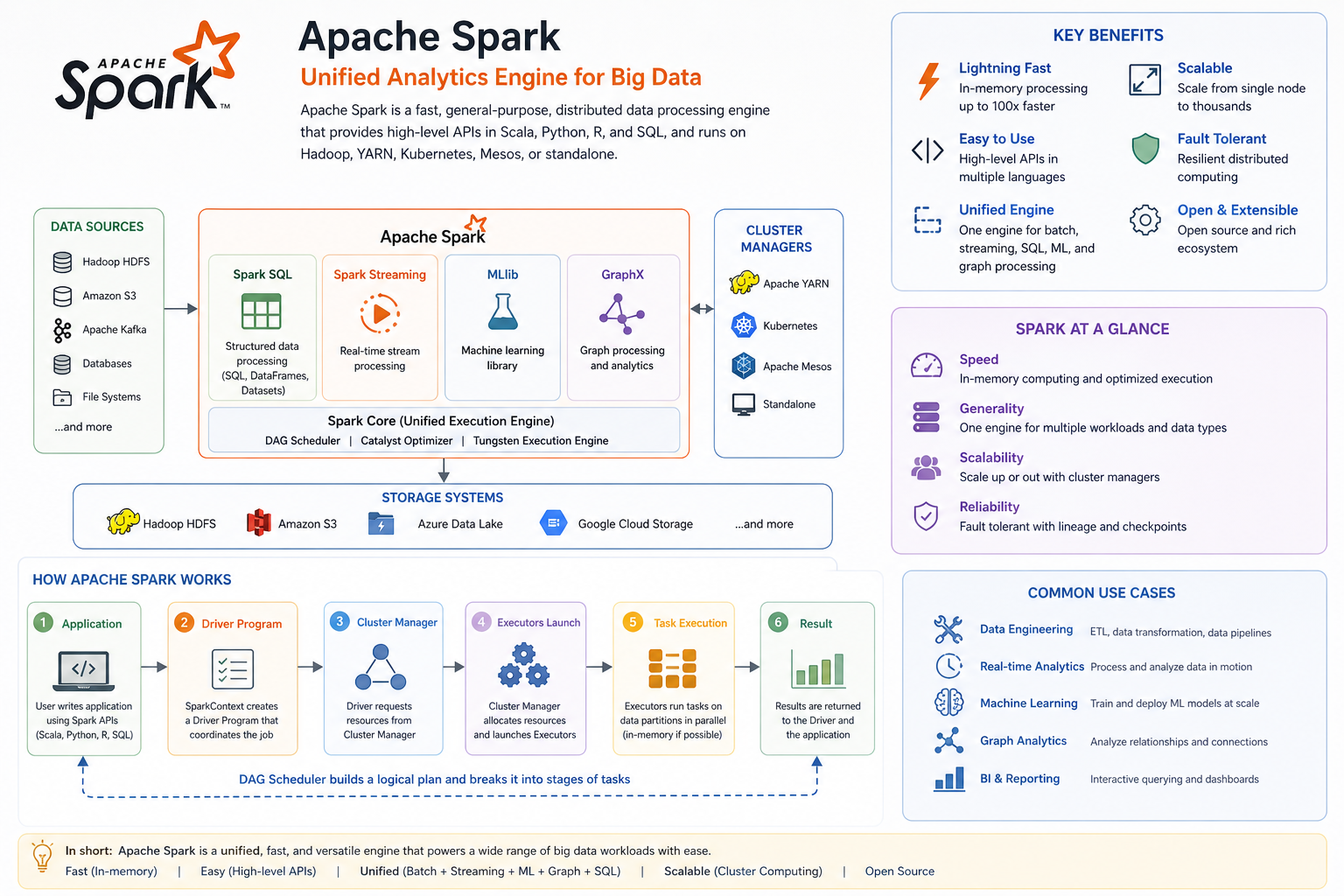
Understanding Stages in Apache Spark
A Spark job can be divided into multiple stages. Each stage contains tasks that can be executed in parallel on the data partitions that do not require data shuffling. Understanding how stages work is crucial for optimizing performance and efficiently managing resources in a Spark application.
How Stages are Formed
Stages in Apache Spark are formed by the DAG (Directed Acyclic Graph) Scheduler during the execution of a Spark job. The DAG Scheduler breaks down a job into stages based on wide transformation boundaries. Wide transformations such as reduceByKey or groupByKey require data shuffling, causing a stage boundary. Narrow transformations, like map or filter, do not require shuffling and can be grouped within the same stage.
Example of Stages in Spark
Consider an example where you have a simple Spark job that calculates the word count from a text file. Here's a Scala example illustrating how stages might be formed:
import org.apache.spark.{SparkConf, SparkContext}

object WordCount {
  def main(args: Array[String]) {
    val conf = new SparkConf().setAppName("WordCountExample")
    val sc = new SparkContext(conf)

    val textFile = sc.textFile("hdfs://path/to/textfile")
    val counts = textFile.flatMap(line => line.split(" "))
                         .map(word => (word, 1))
                         .reduceByKey(_ + _)

    counts.saveAsTextFile("hdfs://path/to/output")
    sc.stop()
  }
}
Explanation:
- FlatMap Transformation: This transformation breaks each line into words. It's a narrow transformation and doesn't require data shuffling, so it remains in the same stage.
- Map Transformation: Creates a key-value pair for each word with an initial count of 1. Like
flatMap, this transformation is also narrow. - ReduceByKey Transformation: This is a wide transformation because it aggregates results across partitions, causing a shuffle and thus initiating a new stage boundary.
- SaveAsTextFile: This action triggers the execution of all preceding transformations, leading to the execution of tasks within stages.
Optimizing Stage Execution
To optimize Apache Spark applications, consider the following tips:
- Minimize Shuffle Operations: Since shuffles are expensive operations, aim to reduce the number of wide transformations when possible.
- Optimize Data Partitioning: Ensure that data is partitioned in a manner that suits the computations, reducing unnecessary shuffles.
- Caching Data: Sometimes caching intermediate RDDs can prevent recomputation and optimize further stage calculations.
Conclusion
Understanding how Spark divides a job into stages helps in optimizing the overall performance of your Spark application. By analyzing the DAG and understanding the boundaries of stages, developers can gain insights into potential bottlenecks and where optimizations might be applied.