Introduction
In this lesson, we delve into the vast ecosystem of Apache Spark, focusing on understanding its architecture components, key features, and the distinctions between Resilient Distributed Datasets (RDDs) and DataFrames. We will also explore Spark SQL, an essential feature for querying structured data at scale, leveraging the programming paradigms introduced in previous lessons.
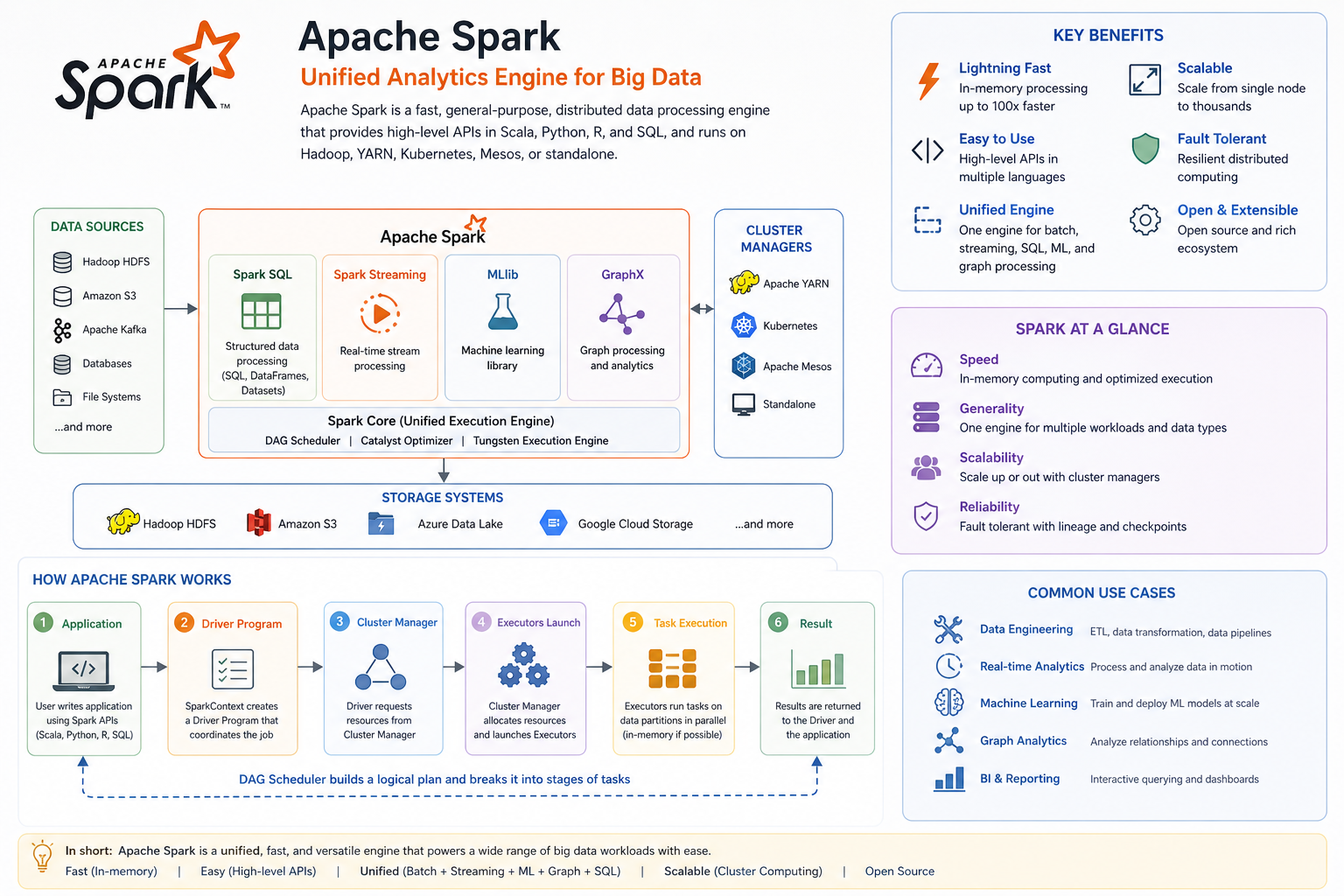
The Spark ecosystem is a collection of tools, libraries, and components built around the framework.
<img height="325" width="579" src="https://yrltjyzsmzdylqvoonwf.supabase.co/storage/v1/object/public/lesson-images/100/181/spark-components-1.jpg" />
Here's an overview of the key components and libraries Spark ecosystem:
- SparkCore: Spark Core is the main component of Apache Spark. It allows developers to interface with Spark's distributed data processing capabilities, making it easier to work with large datasets and perform distributed computing tasks.
- Spark SQL: Spark SQL is a component of Apache Spark that enables SQL-based querying of structured data, including data stored in Spark DataFrames and external data sources. Spark provides API for Spark SQL, allowing users to run SQL queries.
- Spark MLlib: Spark MLlib is Spark's machine learning library. It provides a wide range of machine learning algorithms and tools for building, training, and evaluating machine learning models. Spark offers bindings for MLlib, making it accessible to developers.
- Spark Streaming: Spark Streaming is a real-time data processing component of Spark that allows you to process and analyze data streams in real-time. Spark offers support for Spark Streaming, making it possible to build real-time data processing applications using Scala.
- Spark GraphX: GraphX is a graph processing library for Spark, and PySpark provides Python bindings for GraphX. This allows Python developers to work with graph data structures and perform graph analytics using Spark.
- Spark Extensions: The Spark ecosystem also includes various extensions and third-party libraries that enhance its capabilities. For example, libraries like Koalas provide a Pandas-like API for working with Spark DataFrames, making it easier for Pandas users to transition to PySpark.
Overall, the Spark ecosystem provides Data Engineers with a powerful set of tools for working with large datasets, performing distributed data processing, running machine learning algorithms, and handling real-time data streams. It offers the flexibility and scalability needed to tackle a wide range of big data and data analytics tasks using Scala.