Introduction to Spark SQL
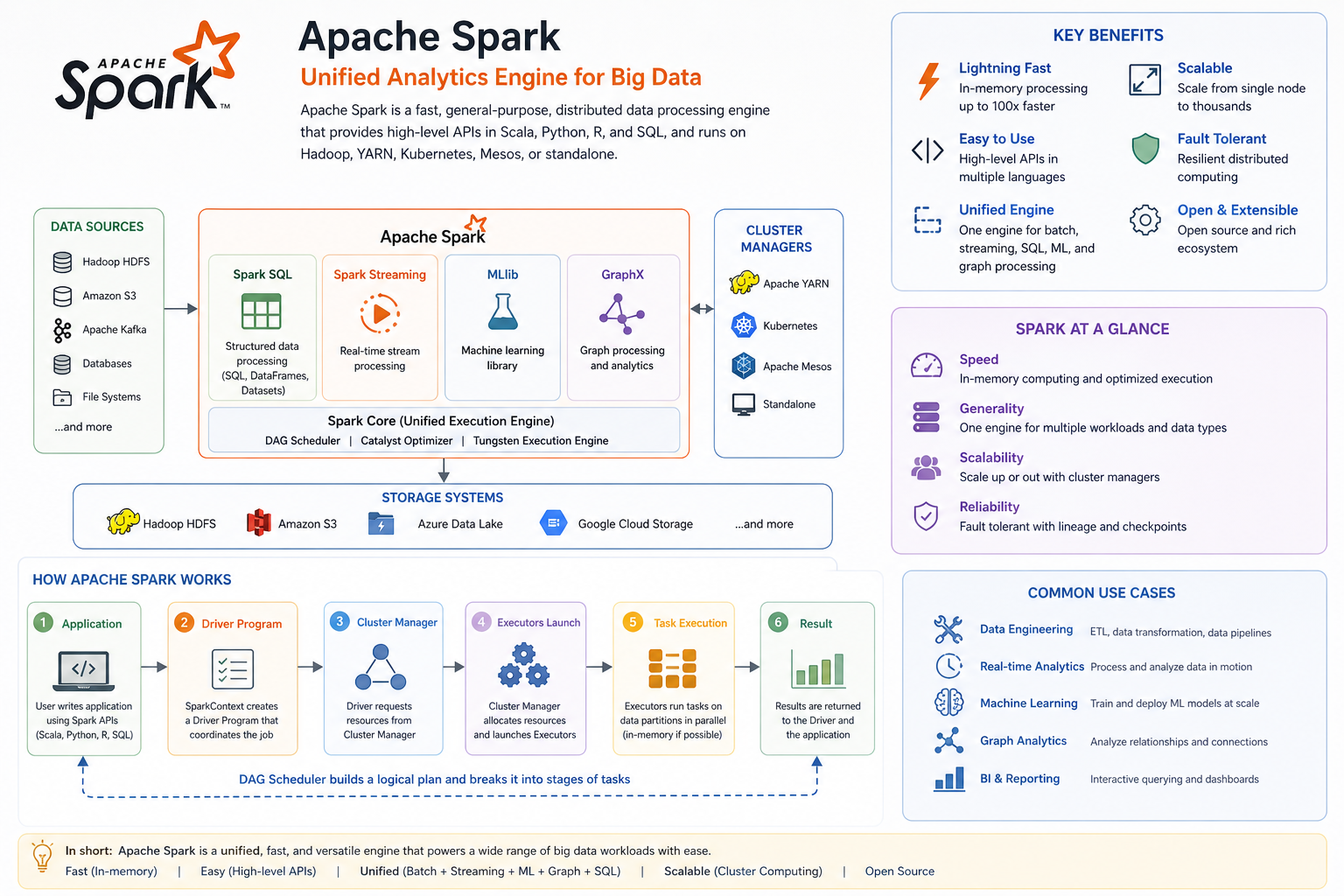
Spark SQL is a powerful module within the Apache Spark ecosystem that facilitates the execution of SQL queries on structured data. It allows users to leverage the capabilities of Spark to process large volumes of data while providing a familiar SQL interface. In this lesson, we will explore the role of Spark SQL in the Spark ecosystem, its benefits, and how it compares to the DataFrame API and Dataset API. We will also delve into some real-world analytics use cases to illustrate its practical applications.
What is Spark SQL?
Spark SQL is a module of Apache Spark designed for working with structured data using SQL. It integrates relational data processing with Spark’s functional programming capabilities. Users can query structured data using SQL, and Spark SQL optimizes these queries under the hood.
Spark SQL allows access to a variety of data sources, including Hive tables, JSON, Parquet, and more. It provides a unified interface for these various data formats, making it a versatile tool within the Spark ecosystem. The primary components of Spark SQL include:
- Catalyst Optimizer: An advanced query optimization engine that transforms SQL queries into efficient execution plans.
- Data Sources API: This allows data from various formats to be read and written in a consistent manner.
- Hive Compatibility: Spark SQL can connect to existing Hive data and metadata, enabling SQL queries using familiar Hive table definitions.
Benefits of Using SQL with Spark
The integration of SQL within Spark offers several benefits:
- Familiarity: Many data analysts and engineers are already comfortable using SQL for querying databases. Spark SQL allows these professionals to interact with big data using their skills without needing to learn a new programming paradigm.
- Performance: The Catalyst Optimizer significantly enhances performance by optimizing SQL queries, reducing execution time when working with large datasets.
- Scalability: Spark SQL scales out to handle big data, ensuring that as data volumes grow, application performance remains stable.
- Integration with Big Data Tools: Spark SQL supports various data sources and can be seamlessly integrated with other big data tools and frameworks, such as Hadoop and Hive. This interoperability is crucial for organizations that have existing infrastructures.
- Unified Analytics: By utilizing Spark SQL, users can combine batch processing and streaming queries in a single application, fostering more dynamic analytics solutions.
SQL vs DataFrame API vs Dataset API
When interacting with Spark, there are different approaches for manipulating data: SQL queries, DataFrame API, and Dataset API. Understanding their differences can help in choosing the right method for specific use cases.
SQL Queries
Using SQL within Spark is straightforward and can be useful for users who prefer traditional querying languages. SQL queries are highly readable and allow for complex joins, aggregations, and transformations.
DataFrame API
A DataFrame in Spark is analogous to a table in a relational database or a DataFrame in R/Python. It provides a higher-level abstraction than RDDs (Resilient Distributed Datasets) and supports operations similar to those in SQL. Operations can be expressed using functional programming constructs, making them potentially faster when optimized, due to Spark’s execution model.
Dataset API
The Dataset API combines the advantages of RDD and DataFrame APIs, providing the ability to work with strongly typed objects in Spark. This means that when using Scala or Java, the compiler can catch errors during compile time instead of at runtime. This is especially beneficial for developers emphasizing type safety in their applications.
| Feature | SQL | DataFrame API | Dataset API | | ----------- | --------------------- | ---------------------- | ------------------------------ | | Language | SQL | Functional Programming | Strongly Typed Programming | | Type Safety | No | No | Yes | | Performance | Catalyst Optimization | Catalyst Optimization | Catalyst Optimization | | Use Case | Familiar SQL Queries | Transforming data | Strongly Typed Transformations |
Real-world Analytics Use Cases
Spark SQL is used in various industries for diverse analytics scenarios, including:
- Business Intelligence: Companies utilize Spark SQL to analyze large datasets and generate insights for decision-making. They can integrate data from different sources, such as sales numbers, customer feedback, and website logs, to create comprehensive reports.
- Data Lake Exploration: Organizations with data lakes can use Spark SQL to query data without needing to move it, making it easier to explore vast datasets and extract meaningful information.
- Machine Learning: In machine learning workflows, Spark SQL helps prepare data for modeling by allowing data engineers to write complex transformations succinctly. This preprocessing step is crucial for building accurate predictive models.
- Log Analysis: Spark SQL is particularly effective for analyzing server log files in real-time, enabling companies to detect anomalies or trends that could affect system performance or user experience.
Summary
In this lesson, we covered the essential aspects of Spark SQL, understanding its role in the Spark ecosystem and the benefits it provides. We discussed the various methods available for data manipulation, including SQL queries, DataFrame API, and Dataset API, highlighting their differences. Lastly, we explored several real-world use cases that illustrate the utility of Spark SQL in analytical contexts. As you continue your journey with Spark, the knowledge gained in this lesson will pave the way for more advanced data analysis techniques.