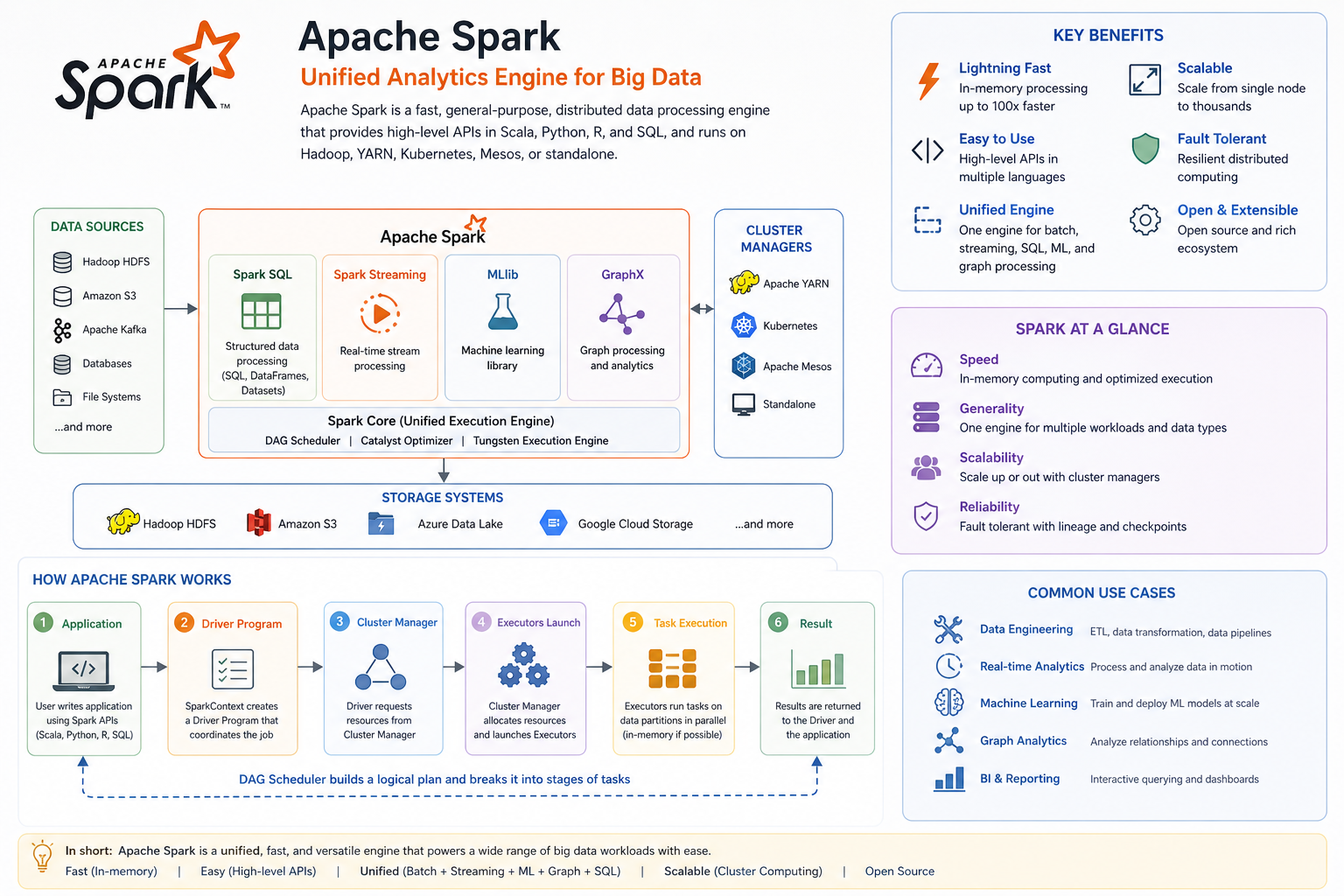
Introduction to Spark Worker
In Apache Spark, a worker node is a crucial component of the cluster that performs the actual data processing tasks. It is responsible for running the tasks assigned by the Spark driver and managing the execution of those tasks.
Role of Spark Workers
At its core, Spark is designed to distribute data processing across many nodes in a cluster. Each of these nodes, called workers, contributes computational power to handle significant data workloads. Workers are responsible for executing a part of the application logic as they process and store data across the cluster.
Inside a Spark Worker
A Spark worker hosts a set of executors. Executors are processes launched on worker nodes that run the computations. Each executor provides in-memory storage for RDDs that are cached and are responsible for executing tasks.
- Executors: These handle task execution and store data and intermediate results in memory.
- Cores and Memory: Executors are allocated a certain number of cores and a specific amount of memory to perform their tasks.
Task Scheduling
The driver program assigns tasks to the executors on various workers. Each task is a single operation, mapped from the RDD, to be performed on a partition of the data.
Example in Scala
Here's a simple example of Spark utilizing workers in Scala:
import org.apache.spark.{SparkConf, SparkContext}

// Set up the Spark configuration and context
val conf = new SparkConf().setAppName("SparkWorkerExample").setMaster("local")
val sc = new SparkContext(conf)

// Create an RDD from a sequence of data
val data = sc.parallelize(Seq(1, 2, 3, 4, 5))

// Perform a simple map operation
val result = data.map(x => x * 2)

// Collect the results
result.collect().foreach(println)

// Stop the Spark context
sc.stop()
In this example, the parallelize method distributes data across the workers, and the map operation is executed in parallel by the executors on the worker nodes.
Conclusion
Spark workers are essential for distributed data processing, as they execute tasks across a cluster of machines. Understanding the role and management of Spark workers allows for optimizing resource utilization and achieving efficient computational performance.
By utilizing Scala in Spark applications, you can effectively manage and execute jobs across multiple worker nodes, thereby leveraging cluster computing power to handle large-scale data processing workloads.