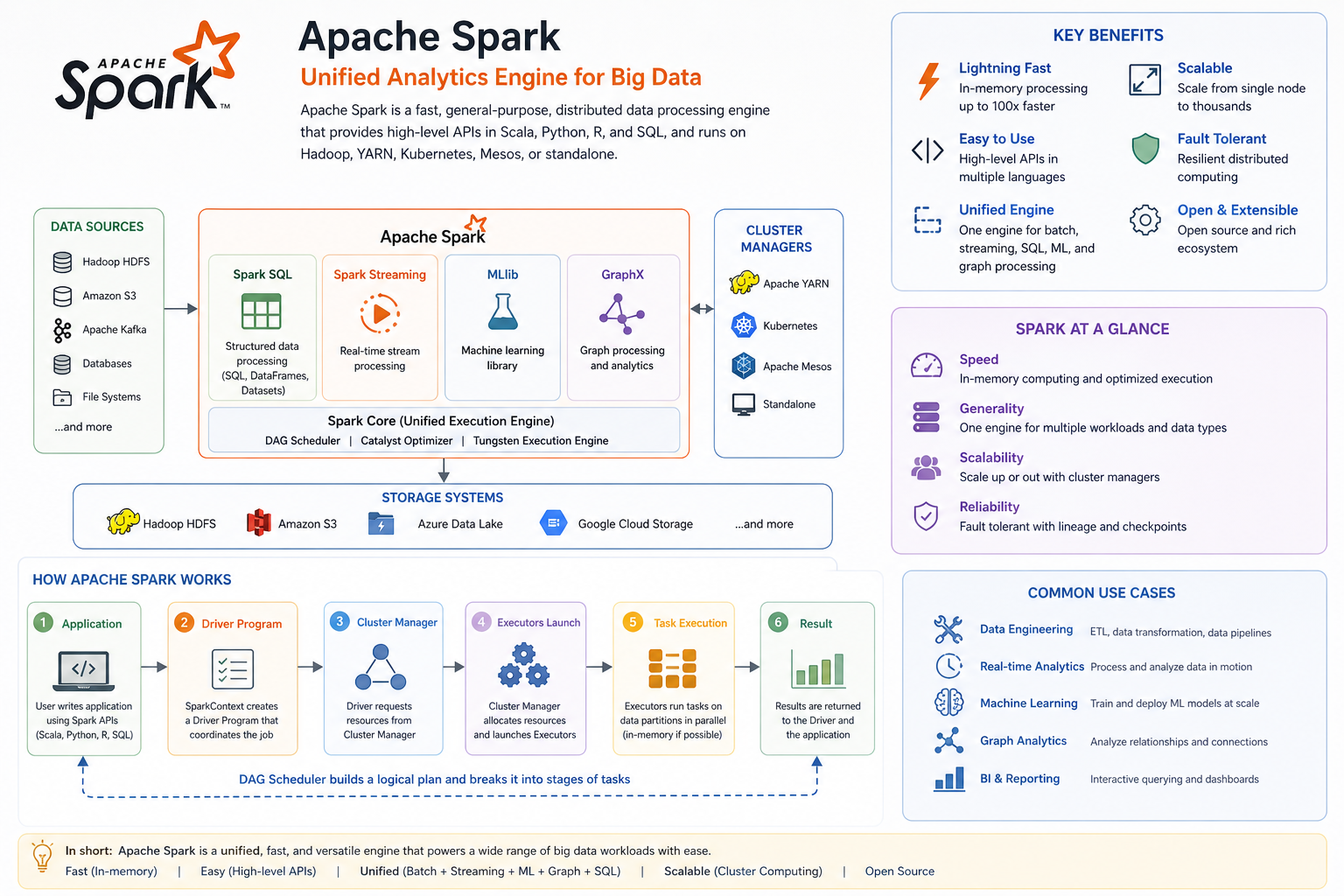
Understanding Lineage in Spark
In Apache Spark, understanding the concept of lineage is crucial for optimizing and debugging your Spark jobs. Lineage represents the logical execution plan, essentially a directed acyclic graph (DAG), that Spark creates for the operations performed on data. This DAG allows Spark to keep track of the transformations and actions you apply to your data, making it possible to understand how data transformations flow and derive the final output from the initial data source.
Why Lineage is Important
-
Fault Tolerance: With lineage, Spark can recover lost data partitions in case of failure. When a node fails, Spark uses the lineage information to recompute lost partitions from the original data and the previously executed transformations.
-
Optimizations: Lineage helps Spark optimize execution plans by understanding which parts of the computation can be collapsed or rearranged to minimize data shuffling and redundancy.
-
Debugging: Lineage allows developers to backtrack and inspect the operations that led to the current state of data. This ability is essential for both troubleshooting errors and for ensuring data quality.
How Lineage Works in Spark
When you apply transformations to an RDD (Resilient Distributed Dataset) or a DataFrame, Spark doesn't immediately compute these transformations. Instead, it records these operations in the lineage graph. Only when an action is called does Spark execute the transformations. Here's how it breaks down:
-
Transformations: These are operations like
map,filter,groupBy, etc., that define how data should be transformed. Transformations in Spark are lazy, meaning they are not computed until an action is called. -
Actions: These trigger the execution of the recorded transformations. Examples include
collect,count,saveAsTextFile, etc. Once an action is called, Spark looks at the lineage graph to compute and output the results.
Visualizing Lineage
Spark provides tools to visualize lineage via the Spark UI, where you can visually inspect the DAG for your Spark jobs. This visualization helps in understanding the flow of data and identifying potential bottlenecks or inefficiencies in the execution plan.
Best Practices for Managing Lineage
-
Use
persist()orcache(): To optimize operations and avoid recalculating certain datasets, usepersist()orcache()to store the dataset explicitly in memory. This practice is especially useful for intermediate results that will be reused multiple times. -
Plan your operations: Understand the transformations needed and minimize unnecessary operations to keep the lineage compact and efficient.
-
Partition wisely: Ensure that your data is well-partitioned to take advantage of parallel computation and reduce shuffling, which can complicate and slow down the computation.
By keeping track of how data transformations are applied and understanding the lineage, developers can create more efficient, reliable, and easier-to-debug Spark applications.