Spark Task
In Apache Spark, a task is a fundamental unit of execution. When a Spark job is submitted, it undergoes several stages of transformation and execution, ultimately broken down into tasks that are executed on worker nodes in the Spark cluster. Understanding how tasks work in Spark is crucial for optimizing performance and efficient resource usage.
Understanding Tasks
A task is essentially a single unit of work, usually representing computations over a partition of data. Each task is executed independently on a single data partition. Tasks are scheduled and executed by the Spark executors on worker nodes.
Task Execution Process
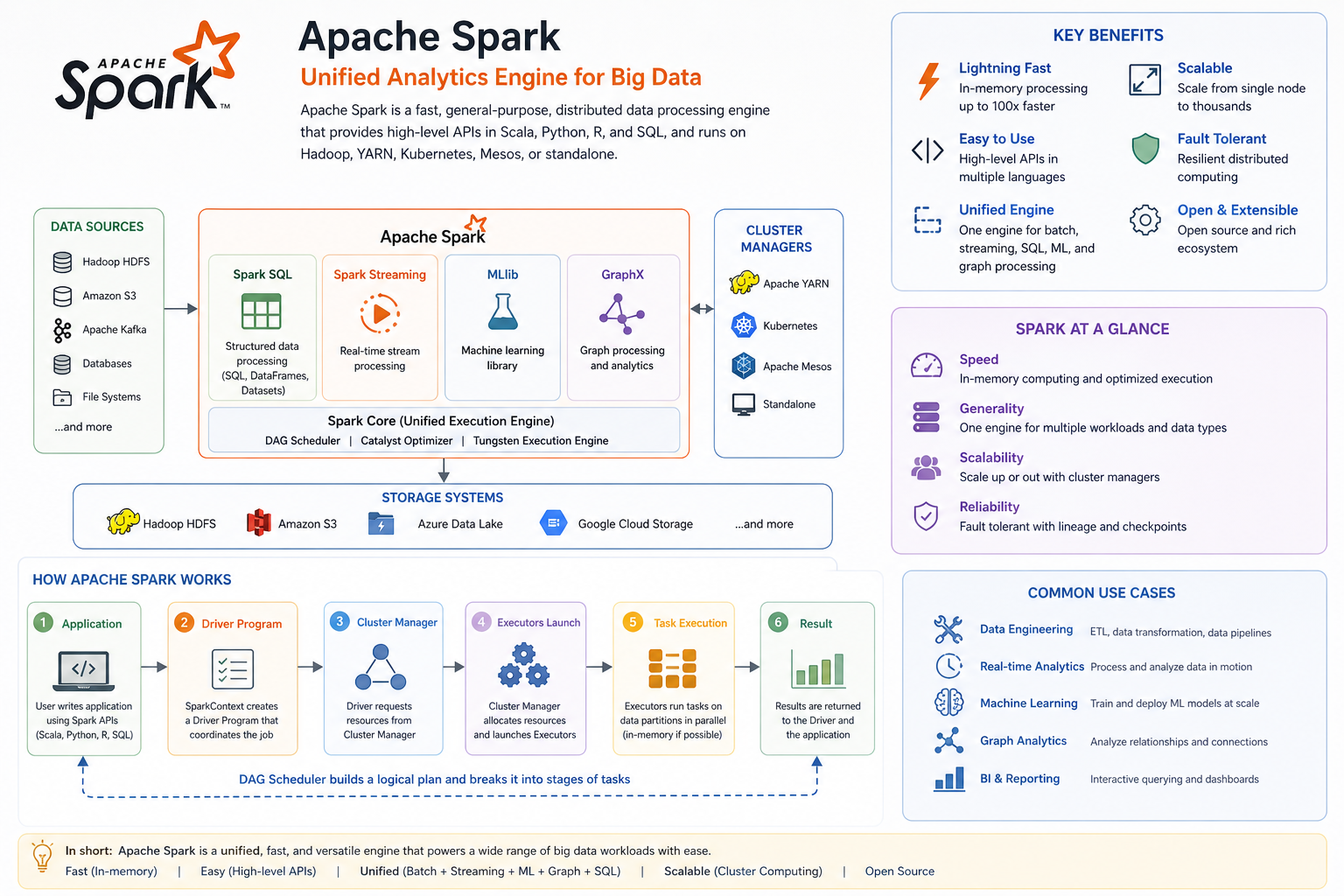
- Job Submission: A Spark application submits a job to the SparkContext.
- DAG Creation: The job is transformed into a Directed Acyclic Graph (DAG), representing a series of transformations on the data.
- Stage Division: The DAG is split into multiple stages, where each stage represents a set of tasks based on transformations that don't require shuffling.
- Task Scheduling: Within each stage, tasks are scheduled for execution on different partitions across the cluster.
Example in Scala
Here's a basic example of how a simple Spark job translates into tasks:
import org.apache.spark.sql.SparkSession

val spark = SparkSession.builder
  .appName("Task Example")
  .master("local[2]")
  .getOrCreate()

val data = Array(1, 2, 3, 4, 5)
val rdd = spark.sparkContext.parallelize(data, 2) // Create an RDD with 2 partitions

val squaredRDD = rdd.map(x => x * x) // Transformation
squaredRDD.collect().foreach(println) // Action

spark.stop()
In this example, an array of integers is parallelized into an RDD with two partitions. The map transformation creates a task for each partition to square the numbers, representing the execution process Spark uses.
Task Optimization Tips
- Proper Partitioning: Ensure data is partitioned correctly to avoid excessive shuffling.
- Efficient Transformations: Use narrow transformations when possible, as they don't require shuffling data across partitions.
- Caching Intermediate Results: Cache frequently accessed data to reduce unnecessary recomputation.
Conclusion
Tasks in Spark represent the granular units of work divided across a cluster. Understanding the lifecycle and behavior of tasks is vital for writing efficient Spark applications. By optimizing task execution and scheduling, you can significantly improve the performance of your Spark applications.