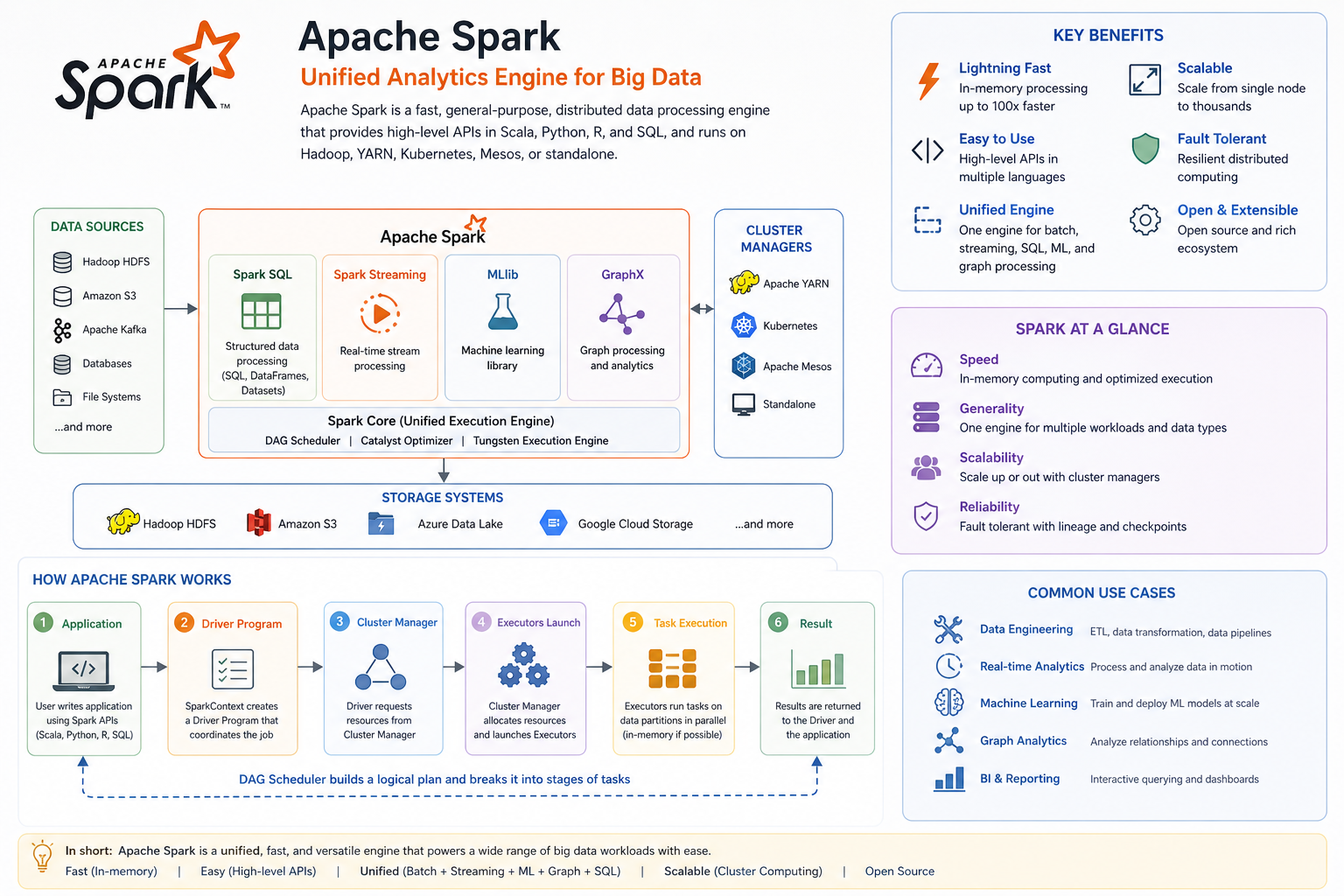
Spark - Directed Acyclic Graph (DAG)
In Apache Spark, the Directed Acyclic Graph (DAG) is a fundamental concept that represents the sequence of computations performed on data. This structural diagram is crucial for understanding how Spark manages and optimizes complex data processing tasks.
What is a DAG?
A Directed Acyclic Graph (DAG) in Spark is a pair of vertices and edges where each edge is directed from one vertex to another. The graph is acyclic, meaning it doesn’t contain any cycles or loops. In Spark, the vertices represent the RDDs (Resilient Distributed Datasets) or data frames, while the edges represent the operations applied to these datasets.
How DAG Works in Spark
When a Spark application runs, a DAG is constructed. This DAG represents all transformations and computations. At each stage of the DAG, Spark creates a chain of transformations linked together. The DAG scheduler then organizes these transformations into stages, ensuring that all necessary computations are performed efficiently.
-
Logical Execution Plan: Initially, when you write a Spark program, Spark generates a logical execution plan. This plan details the sequence of transformations from the dataset’s origin.
-
Physical Execution Plan: Spark translates the logical plan into a physical execution plan, which can be optimized and executed across the cluster.
-
Stages and Tasks: The DAG is split into various stages, which are sets of transformations that can be computed without shuffling data. Each stage contains tasks based on partitions of the input data.
Importance of DAG Optimization
The DAG layout allows Spark to accomplish several optimizations beyond Hadoop’s MapReduce capabilities, such as:
-
Pipelining operations: Spark can execute transformations in sequence within one stage without writing intermediate data to disk.
-
Reducing data shuffling: By combining operations into stages and optimizing data flow, Spark minimizes the cost of shuffling data across the cluster.
Visualization
Visualizing the DAG can help developers understand what operations are being executed and how data is flowing through various transformations. Tools within Apache Spark UI allow users to inspect the DAG, examine the stages, and debug any issues with their applications.
Managing Execution with DAG
By leveraging DAGs, Spark efficiently manages task execution and resource allocation. The separation of processes into different stages can be utilized to spot bottlenecks and improve the overall performance of Spark applications.
Conclusion
Understanding and working with DAGs in Apache Spark is critical for optimizing data processing workflows and effectively handling large-scale datasets. By visualizing and managing DAGs, developers can write better-performing Spark applications that make the most out of cluster resources.