Introduction
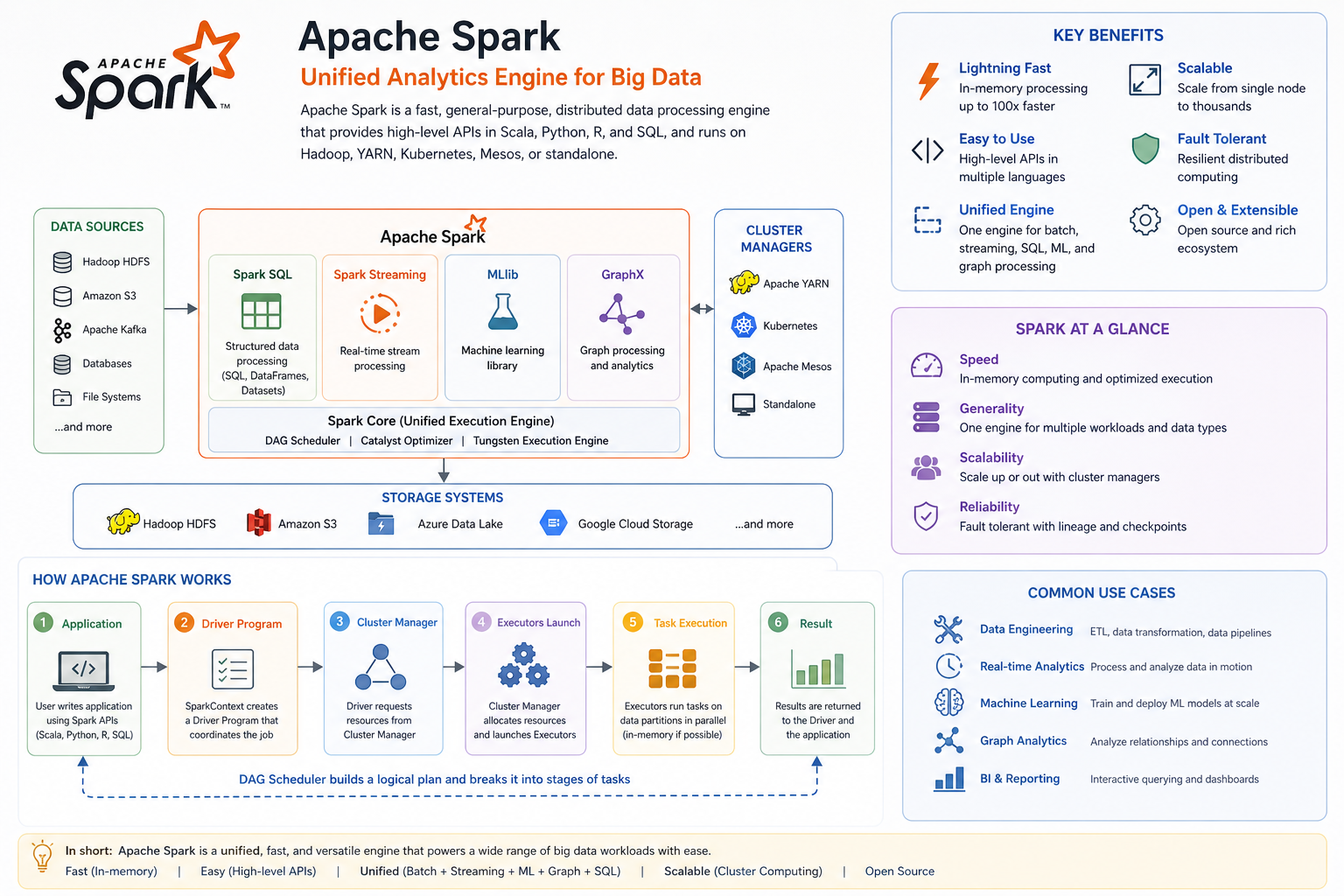
This lesson dives into the concept of Dataset transformations in Apache Spark, specifically focusing on Scala as the programming language. By understanding how to manipulate Datasets, you'll be empowered to manage and process large volumes of data efficiently. We will explore various transformations like map, flatMap, and filter, using a Person case class to illustrate these concepts. The lesson will also cover the difference between typed and untyped transformations, the role of lambda expressions, and provide real-world examples of how these transformations can be applied, such as in data cleaning and enrichment scenarios.
Overview of Datasets
Datasets in Spark are a distributed collection of data that is similar to RDDs but provides the benefits of Catalyst optimization and improved typing. Datasets can be viewed as either strongly typed or untyped. Strongly typed Datasets leverage Scala’s type system to provide compile-time type safety.
The Person Case Class
To facilitate our understanding, we will define a simple Person case class that holds information about an individual. Here's how the Person case class looks like:
case class Person(name: String, age: Int, city: String)
Dataset Transformations
Transformations are operations on Datasets that return a new Dataset. These are lazy operations which means they don’t compute their results immediately; instead, they are computed when an action is called. Below are the primary transformations we will cover:
map Transformation
The map transformation allows you to transform each element of the Dataset into a new element. This is useful when you want to apply a function to each item and return a new Dataset.
Example
In the case of our Person class, you can create a Dataset of Person objects and then use the map transformation to convert them into a Dataset of Strings representing their names:
val people = Seq(
  Person("Alice", 29, "New York"),
  Person("Bob", 32, "Los Angeles"),
  Person("Cathy", 25, "Chicago")
)

val peopleDS = spark.createDataset(people)
val namesDS = peopleDS.map(person => person.name)
# Output
// Output Dataset containing: Alice, Bob, Cathy
flatMap Transformation
The flatMap transformation is similar to map, but it flattens the results into a single Dataset. This is useful when a single input element can produce multiple output elements.
Example
Suppose we want to convert our Person objects to a more detailed string format:
val detailDS = peopleDS.flatMap(person => Seq(s"Name: ${person.name}, Age: ${person.age}, City: ${person.city}"))
# Output
// Output Dataset containing: Name: Alice, Age: 29, City: New York, ...
filter Transformation
The filter transformation returns a new Dataset containing only those elements that satisfy a certain condition. This can help in narrowing down data based on specific criteria.
Example
For instance, if we want to filter our peopleDS to only include persons older than 30:
val adultsDS = peopleDS.filter(person => person.age > 30)
# Output
// Output Dataset containing: Bob
Typed vs Untyped Transformations
Typed transformations are applicable to Datasets, where the type is known at compile-time, whereas untyped transformations occur on DataFrames, where the schema is inferred at runtime. Typed transformations provide type safety, compiling-time errors, and more expressive APIs. Conversely, untyped transformations allow for more dynamic queries but with less type safety.
Example of Typed Transformation
Using our peopleDS Dataset:
val youngAdultsDS = peopleDS.filter(person => person.age < 30)
Example of Untyped Transformation
If we were using DataFrames instead of Datasets:
val df = peopleDS.toDF()
val youngAdultsDF = df.filter(df("age") < 30)
Using Lambda Expressions
Lambda expressions provide a way to define anonymous functions, which can be particularly useful when applying transformations. In Spark, you can often use lambda expressions directly, as we seen in previous examples with map and filter.
Example
Using a lambda for filtering:
val filteredDS = peopleDS.filter(_.age < 30)
Real-world Transformation Examples
Dataset transformations play a critical role in data pipelines, especially in scenarios like data cleaning and data enrichment. Cleaning might involve filtering out invalid records or standardizing values, while enrichment could involve combining external data sources with existing Datasets.
Data Cleaning Example
Assuming we have an incoming Dataset of Person objects which may contain missing names or invalid ages:
val cleanDS = peopleDS.filter(person => person.name.nonEmpty && person.age > 0)
Data Enrichment Example
Consider a scenario where we want to enrich our Person Dataset with a country field based on city values:
val enrichedDS = peopleDS.map(person => person.copy(country = getCountryByCity(person.city)))
In this case, getCountryByCity is a hypothetical function that maps cities to countries.
Summary
In this lesson, we explored Dataset transformations in Apache Spark using Scala, focusing on map, flatMap, and filter. We also differentiated between typed and untyped transformations and illustrated the use of lambda expressions. Finally, we looked at real-world applications of these transformations, highlighting their importance in data cleaning and enrichment. Understanding these concepts will enable you to build robust data processing pipelines effectively.