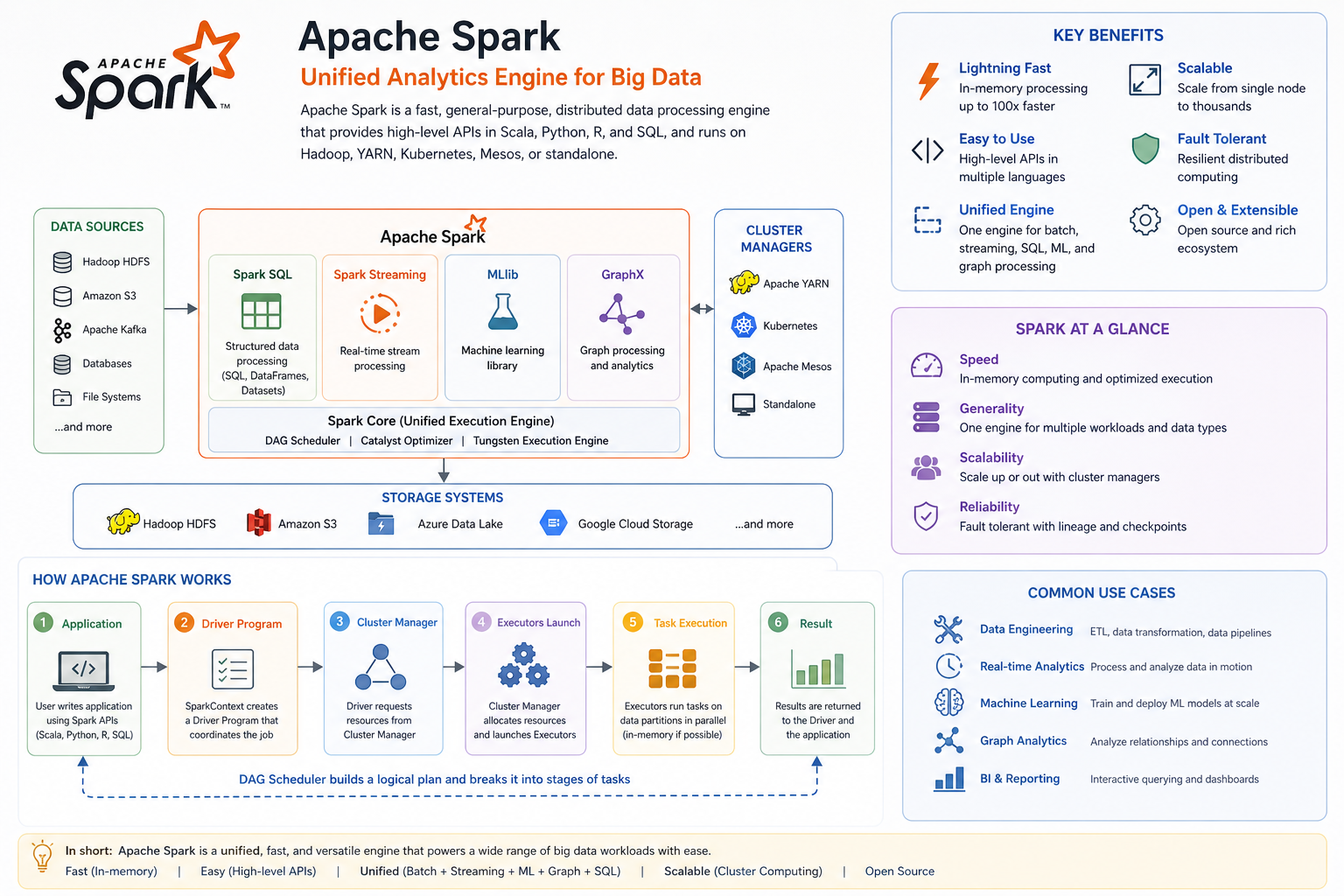
Introduction
In the realm of distributed computing, resiliency is a critical attribute. Fault tolerance is a defining feature of Apache Spark, and it is primarily facilitated through its core abstraction layer: Resilient Distributed Datasets (RDDs). In this lesson, you'll explore the mechanisms that enable RDD fault tolerance, focusing on lineage, data recovery, and checkpointing strategies. These concepts are vital for ensuring data reliability and consistency in the face of hardware failures or network issues.
Definition of Fault Tolerance in RDDs
Fault tolerance in RDDs pertains to Spark's ability to automatically recover lost data across its computing cluster. This enables continuous processing without data loss or manual intervention, a necessity when working with large datasets distributed over numerous nodes.
Mechanisms Enabling RDD Fault Tolerance
The primary mechanism that facilitates fault tolerance in RDDs is the lineage graph. Every RDD maintains metadata that references its source data and transformation operations, allowing it to be recalculated in the event of a node failure. Additionally, Spark automatically partitions RDDs across different nodes, enhancing their availability and reducing the impact of failures.
Lineage and Its Role in Data Recovery
Lineage is a fundamental concept in achieving RDD fault tolerance. Each RDD tracks the sequence of transformations that were applied to the initial data to generate the RDD. This implies that if a partition of an RDD is lost due to failure, Spark can reconstruct it by replaying the sequence of transformations on the original data:
val initialRdd = sc.textFile("hdfs://data/largefile.txt")
val filteredRdd = initialRdd.filter(line => line.contains("spark"))
val mappedRdd = filteredRdd.map(line => (line, line.length))
In this sequence, if mappedRdd loses a partition, Spark can regenerate it by reapplying the filter and map transformations to initialRdd.
Checkpointing Strategies for RDDs
While lineage-based recovery is efficient, recomputing RDDs from scratch can become expensive for long dependency chains. Checkpointing is an advanced strategy used to alleviate this issue by saving the RDD to a more stable storage, truncating the lineage. This is especially useful in long-running Spark applications:
// Set the checkpoint directory
sc.setCheckpointDir("hdfs://checkpoint/dir")

// Create an RDD and set it to be checkpointed
val rdd = sc.parallelize(Array(1, 2, 3, 4, 5))
val filteredRdd = rdd.filter(_ % 2 == 0)
filteredRdd.checkpoint()
Implementing checkpointing ensures that the RDD does not need to recompute transformations from the source data, thus improving performance in fault recovery scenarios.
Best Practices for Resilient RDD Operations
- Minimize Data Loss: Regularly checkpoint important RDDs, especially in applications with long-running jobs.
- Optimize Resource Usage: Use Spark's caching and persistence efficiently to balance memory usage with computation time.
- Monitor Lineage Chain Length: Limit the length of RDD lineage chains to avoid excessive recomputations. Frequent checkpointing or caching can help manage this.
- Use Fault-tolerant Resource Managers: Deploy Spark on stable, reliable clusters managed by robust resource managers like YARN or Kubernetes to ensure high availability of nodes and data.
- Design for Scalability: Structure your RDD transformations to leverage Spark's parallel processing capabilities, ensuring that each node contributes optimally without becoming a single point of failure.
Summary / Key Takeaways
In this lesson on Fault Tolerance in RDDs, you have learned:
- Fault tolerance is critical in Spark's RDDs for resilient data processing.
- RDD lineage enables automatic recomputation of lost partitions, ensuring data recovery.
- Checkpointing saves the state of an RDD, trimming lineage to improve computation efficiency.
- Lineage and checkpointing together form the backbone of Spark's fault tolerance strategies.
- Best practices include minimizing data loss, optimizing resource usage, managing lineage, and ensuring high availability through reliable resource managers.