Introduction
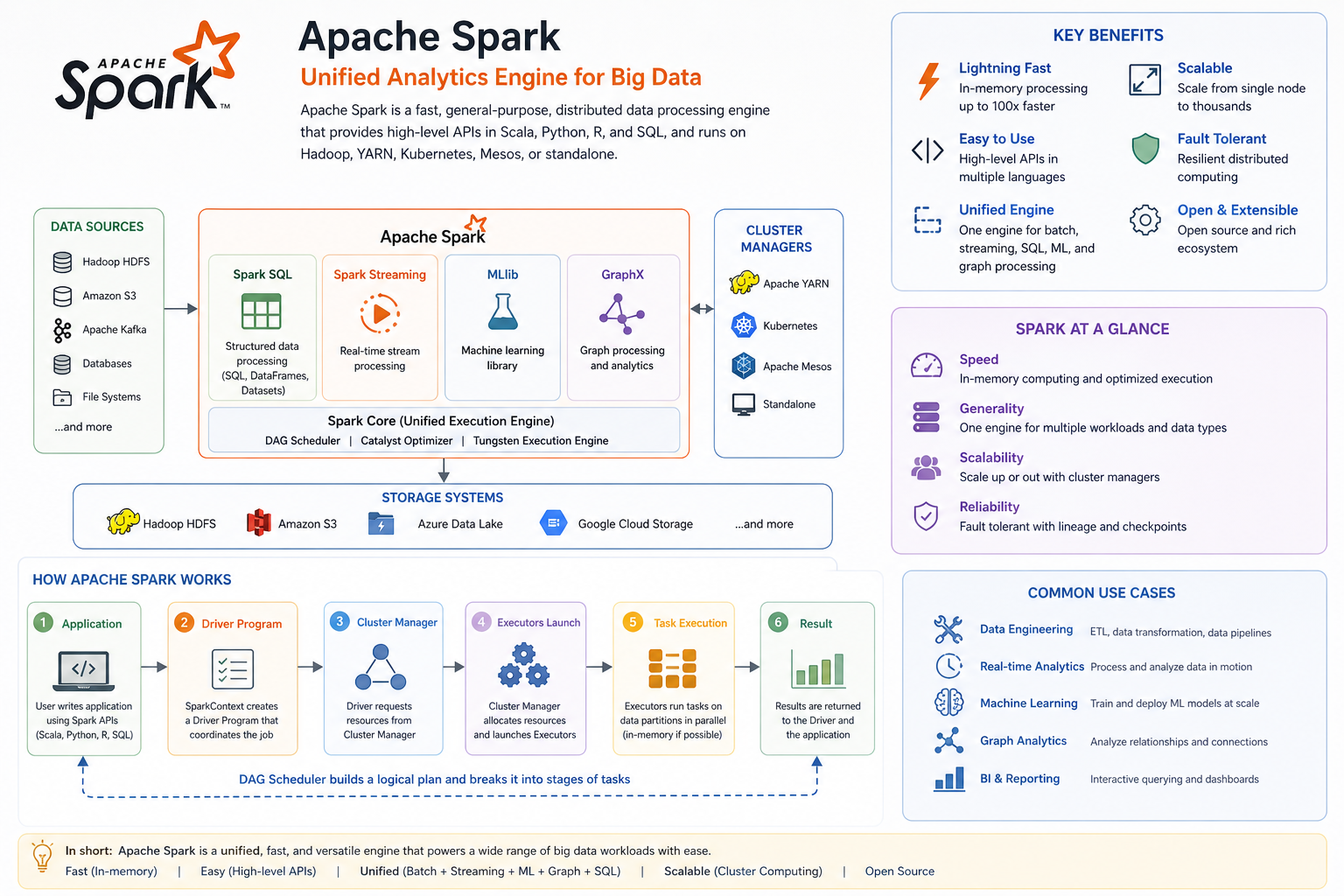
This lesson covers the various actions that can be performed on Datasets in Apache Spark using Scala. Actions are operations that trigger the execution of the Spark computation and return a value to the driver program. Unlike transformations, which are lazy and do not immediately compute results, actions force the execution of the DAG (Directed Acyclic Graph) of transformations that have been applied to the Dataset. By the end of this lesson, learners will understand the key actions available in Spark, how lazy evaluation affects execution, and how to interpret execution plans through practical examples.
Common Actions
In Apache Spark, several common actions are frequently employed when working with Datasets. Below are some of the most utilized actions:
Show
The show() action is used to display the top rows of a Dataset in a tabular format. You can specify the number of rows to display as an argument. For example:
val data = Seq((1, "Alice"), (2, "Bob"), (3, "Cathy"))
val ds = spark.createDataset(data)
ds.show(2) // Displays the first 2 rows
The output of the above code will be:
+---+-----+
| _1| _2  |
+---+-----+
|  1|Alice|
|  2|  Bob|
+---+-----+
Collect
The collect() action retrieves all the elements of the Dataset as an array or a list, which is then available to the driver program.
val collectedData = ds.collect()
Using collect() will bring all the data to the driver node, which should be done cautiously with large datasets as it can lead to memory issues.
Count
The count() action counts the number of elements in the Dataset. This is particularly useful for quick insights into dataset sizes.
val numberOfRows = ds.count()
This action will return a long integer denoting the count of rows present in the Dataset.
First
The first() action will return the first element of the Dataset. It is similar to head(), but first() guarantees that it runs as an action.
val firstElement = ds.first()
This returns the first row of the Dataset directly to the driver.
Lazy Evaluation Concept
In Spark, transformations (e.g., map, filter) are
lazy, which means they are not executed until an action is called. This results in Spark minimizing the processing work. Lazy evaluation helps in optimizing the execution plan by allowing Spark to reorganize operations for more efficient execution.
For instance, if you perform multiple transformations on a Dataset before calling an action, Spark will analyze the entire lineage of operations and minimize shuffles and data transfers during execution.
Triggering Execution
Actions trigger execution in Spark. When an action is called, Spark's execution engine builds a physical execution plan based on the transformations defined preceding the action. It takes into account data locality and optimizes the order of tasks.
Understanding Execution Plans
Execution plans in Spark are crucial for understanding how the framework optimizes operations. When an action is triggered, Spark provides a detailed execution plan, including all stages, tasks, and data movement across nodes.
You can use the explain() method on a Dataset to view the logical and physical execution plans:
ds.explain()
This will provide insight into the underlying operations Spark will perform, which can help in troubleshooting performance bottlenecks. The explain() method will detail the steps involved in the execution, including optimizations Spark has made.
Real-Time Example
To illustrate the actions on Datasets and the effect of lazy evaluation, consider a scenario where you have a large Dataset representing customer transactions. You want to filter transactions for a specific period, calculate the total sales, and display the top transactions. Using the different actions, the workflow might look like this:
// Assuming transactions is a Dataset[(String, Double)]
val filteredTransactions = transactions.filter(t => t._1.startsWith("2022-01-"))
val totalSales = filteredTransactions.map(_._2).sum()
filteredTransactions.show(10)
In this example, the filter is a transformation and remains lazy until an action like show is invoked. The overall computation will only execute once show or collect is called, allowing Spark to optimize the entire operation before executing.
Summary
In this lesson, we explored the various actions available on Datasets in Apache Spark, including show, collect, count, and first. We also discussed the concept of lazy evaluation, which allows Spark to defer execution until absolutely necessary, optimizing your resource usage. Triggering execution through actions also leads to the generation of detailed execution plans, which are essential for understanding and troubleshooting data processing in Spark. Understanding these actions and their implications is vital for effective data engineering with Apache Spark.