What does SparkContext do?
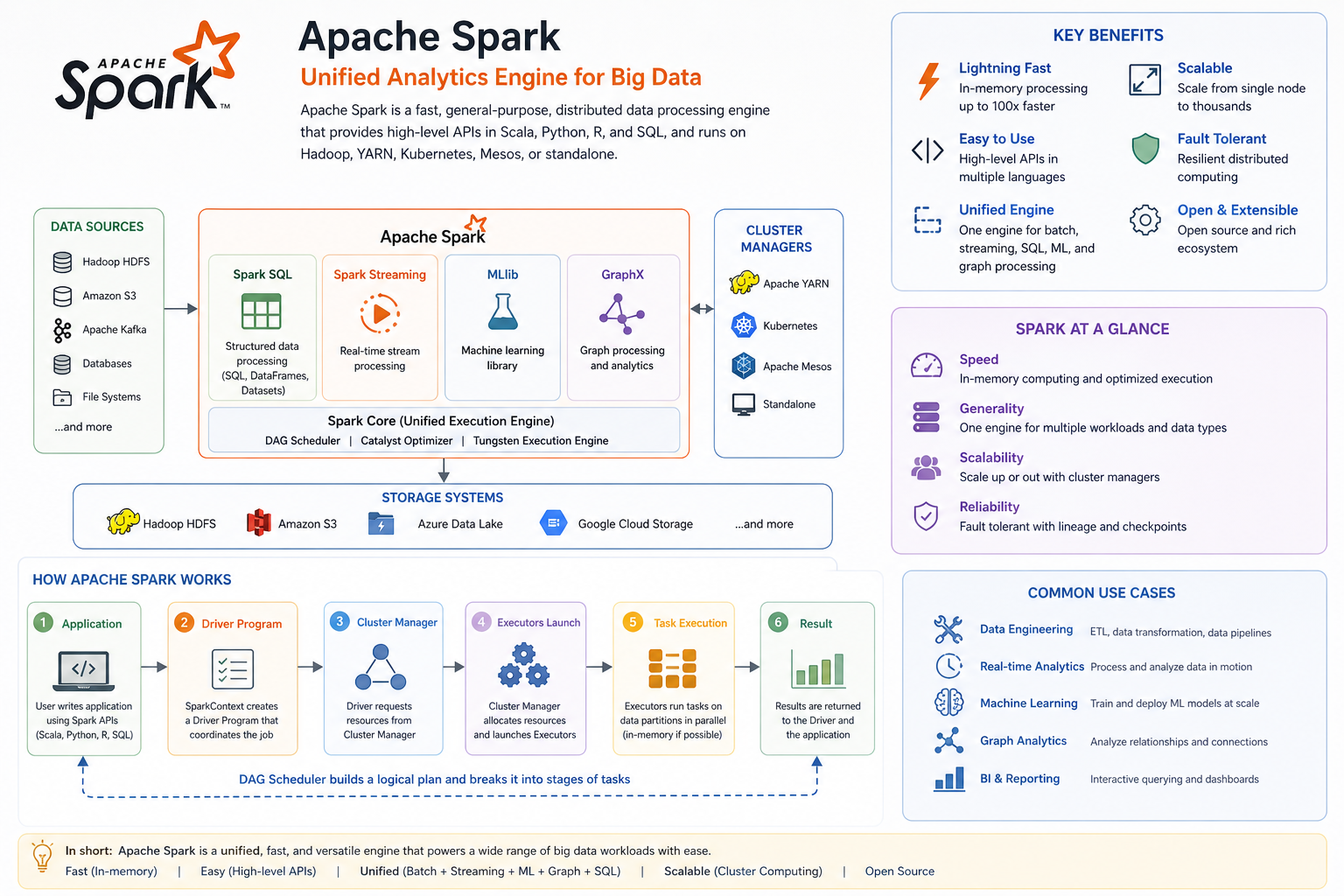
As you learned in previous lessons, this SparkContext is a fundamental component of Apache Spark. It plays a very important role in managing and coordinating the execution of Spark applications. Below is an overview of what the SparkContext does.
I will again take the below diagram as a reference.
<img height="311" width="581" src="https://aistudylabs.com/wp-content/uploads/2023/09/image-8.png" />
- Initialization: The primary role of the
SparkContextis to initialize and set up the Spark application. It establishes a connection to the Spark cluster or local execution environment and coordinates various aspects of the job. - Resource Allocation: The
SparkContextis responsible for managing the allocation of resources, including CPU cores and memory, for the Spark application. It ensures that tasks are distributed across available nodes in the cluster efficiently. - Cluster Coordination: It coordinates the execution of tasks across the cluster. This includes scheduling tasks, managing dependencies between tasks, and ensuring that tasks are executed in parallel to achieve maximum performance.
- Distributed Data: The
SparkContextis responsible for creating and managing distributed data structures, such as Resilient Distributed Datasets (RDDs) and DataFrames. RDDs are the fundamental data abstraction in Spark, and theSparkContextis used to create, transform, and persist them. - Configuration Management: It manages configuration settings for the Spark application, such as memory settings, execution modes, and cluster manager configurations. You can set and adjust these configurations through the
SparkContext. - Driver Program: The
SparkContextruns in the driver program, which is the entry point for a Spark application. The driver program is responsible for coordinating the overall execution and interacting with the user. - Logging and Monitoring: The
SparkContextprovides facilities for logging and monitoring the progress and performance of the Spark application. You can use log messages and monitoring tools to track the execution of your Spark job. - Error Handling: It manages error handling and recovery mechanisms. In case of a task fails,
SparkContextcan reassign it to another node in the cluster to ensure fault tolerance. - Cleanup: When the Spark application is finished or explicitly stopped, the
SparkContextperforms cleanup tasks, releases allocated resources, and gracefully shuts down the Spark application.
In Summary, SparkContext is the unified entry point and controller for Spark applications. It manages resources, coordinates tasks, and provides the necessary infrastructure for distributed data processing in Spark. It plays a vital role in ensuring the efficient and fault-tolerant execution of Spark jobs.