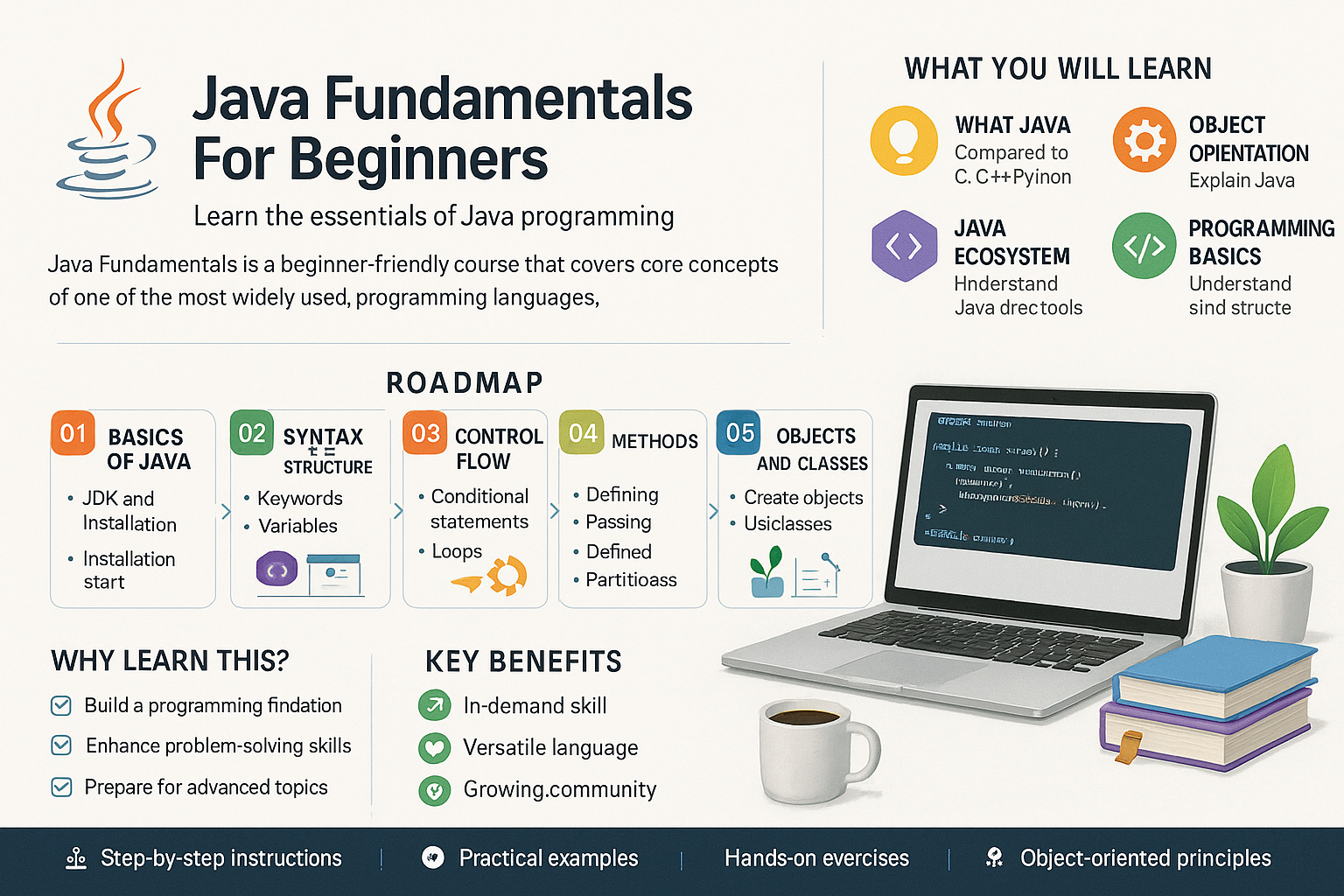
Introduction
In this lesson, we will explore the foundational aspects of the Java programming language. We will cover its rich history, key features, and the importance of its platform independence. Additionally, we will delve into the role of the Java Virtual Machine (JVM) and discuss why Java remains relevant in today's programming landscape.
History and Evolution of Java
Java was developed by Sun Microsystems in the early 1990s and released in 1995 as a core component of the Java Platform. The language was designed by James Gosling and was initially intended for interactive television. However, it began to gain traction as a general-purpose programming language due to its versatility and robustness.
Over the years, Java has evolved significantly:
- Java 1.0 (1996): The first official version, introducing core libraries and applet support.
- Java 2 (1998): Introduced Swing, Collections Framework, and the concept of the Java Platform as three distinct editions (J2SE, J2EE, J2ME).
- Java 5 (2004): Added generics, annotations, enumerated types, and the enhanced for loop.
- Java 8 (2014): Introduced lambda expressions and the Stream API, enhancing functional programming capabilities.
- Java 17 (2021): The latest Long-Term Support (LTS) version, includes features like sealed classes and pattern matching.
Key Features of Java
Java is known for its powerful features that contribute to its popularity in software development:
- Object-Oriented: Java follows the object-oriented paradigm, promoting modular design and code reuse.
- Platform Independence: Write once, run anywhere (WORA) - Java code can run on any device that has a Java Virtual Machine (JVM).
- Automatic Memory Management: Java includes a built-in garbage collector that helps manage memory allocation efficiently.
- Rich Standard Library: Provides a vast set of APIs for networking, I/O, data structures, and more, simplifying development.
- Strongly Typed: Java enforces strong type checking, reducing errors at compile-time.
Platform Independence
One of the hallmark features of Java is its platform independence. This is achieved through the use of the Java Virtual Machine (JVM). When Java code (which is compiled into bytecode) is executed, it is not run natively on the operating system but rather inside the JVM.
This means that once Java source code is compiled into bytecode, it can run on any system that has a JVM installed, regardless of the underlying hardware and operating system. This flexibility makes Java a versatile choice for cross-platform application development.
The Java Virtual Machine (JVM)
The JVM plays a crucial role in Java's architecture and also facilitates its platform independence:
- Execution Environment: The JVM converts bytecode into machine code, enabling the Java program to execute on any platform.
- Memory Management: The JVM handles memory allocation and deallocation via the garbage collector, preventing memory leaks.
- Security: The JVM provides a secure environment for Java applications, restricting potentially harmful operations and executing in a controlled sandbox.
Java's Relevance in Modern Programming and Technology
Despite the emergence of numerous programming languages, Java continues to be a dominant force in the tech industry. Its relevance can be attributed to several factors:
- Enterprise Applications: Java is the backbone of many large-scale enterprise applications, especially on server-side components.
- Android Development: Java is the primary language for Android app development, driving mobile technology.
- Big Data Technologies: Many big data frameworks like Hadoop and Apache Spark are written in Java.
- Cloud-Based Applications: Java is widely used for building cloud-based applications due to its scalability and reliability.
Practical Example
Let's illustrate a simple Java program that prints "Hello, World!" to understand Java syntax:
public class HelloWorld {
    public static void main(String[] args) {
        System.out.println("Hello, World!");
    }
}
Explanation of the Program
In this example:
public class HelloWorld: This defines a class namedHelloWorld.public static void main(String[] args): This line defines themainmethod, which is the entry point of any Java application.System.out.println("Hello, World!"): This line printsHello, World!to the console.
Output
Hello, World! // Output
In the next lessons I will provide more detailed explanation of this example. At this moment you don't have to know all the details.
Summary / Key Takeaways
In this lesson on what Java is, you have learned:
- History: Java was developed in the 1990s and has undergone significant evolution with key versions enhancing its capabilities.
- Key Features: Java is object-oriented, platform-independent, has automatic memory management, a rich library, and strong typing.
- Platform Independence: Java's ability to run on different systems stems from its use of the JVM.
- JVM Role: The JVM executes Java bytecode, manages memory and enhances application security.
- Modern Relevance: Java remains crucial for enterprise applications, Android development, big data technologies, and cloud applications.