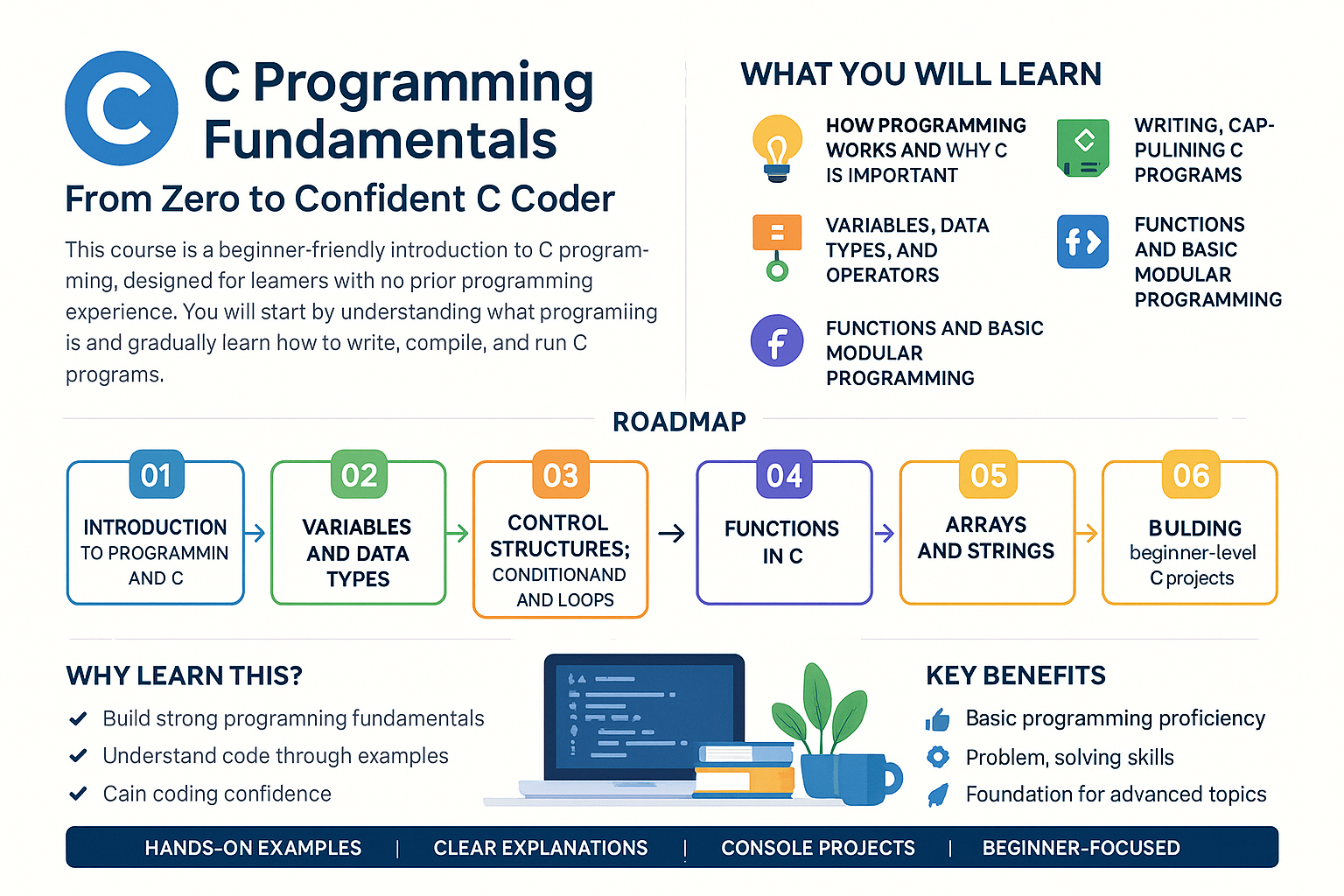
Introduction
In this lesson, we will delve into the fundamental concept of programming, a cornerstone of modern technology. By defining programming and its significance, we will explore the components that form the basis of programming languages, distinguish between low-level and high-level programming languages, and understand how programming serves as a powerful tool in solving real-world problems. Additionally, we will look at the role of the C programming language in the broader programming landscape.
What is Programming?
Programming is the process of creating a set of instructions that a computer can follow to perform specific tasks. These instructions, known as code, are written in programming languages that allow programmers to communicate with computers efficiently. The importance of programming in technology is paramount; it drives innovation, enables automation, and provides solutions across various industries, from software development to data analysis.
Basic Components of Programming Languages
Programming languages possess several fundamental components:
Syntax
- Syntax refers to the set of rules that define the structure of the program. Each programming language has its own syntax. For instance, in C, statements end with a semicolon (
;).
Semantics
- Semantics involve the meaning of the instructions. This is how programming languages interpret the syntactic structures. For example, when a compiler sees an assignment statement, it understands that a value is being stored in a variable.
Data Types
- Different types of data (e.g., integers, characters, floats) determine how the data can be manipulated. C has several data types such as
int,float,char, etc.
Control Structures
- These define the flow of execution in a program. They allow programmers to implement conditional logic (using
if,else) and loops (usingfor,while).
Functions
- Functions are reusable blocks of code that perform specific tasks. They help maintain a clean and organized program structure.
Low-Level vs. High-Level Programming Languages
Programming languages are broadly categorized as low-level and high-level:
Low-Level Languages
- Low-Level Languages are closer to machine code and include Assembly and machine language. They provide little abstraction, making it possible to write programs that are optimized for speed and memory use. However, they can be complex and hardware-specific.
High-Level Languages
- High-Level Languages, like C, Python, and Java, abstract the complexity of the hardware. They are user-friendly and closer to human language, which makes them easier to learn and use. High-level languages allow developers to write programs that are portable across different systems.
Example of a High-Level Language - C
#include <stdio.h>

int main() {
    printf("Hello, World!\n");
    return 0;
}
Explanation of the Code
In this C program, we include the stdio.h header file for input/output functions. The program defines the main function, which is the entry point of the code. The printf function prints "Hello, World!" to the console. The return 0; statement indicates that the program has executed successfully.
Expected Output:
Hello, World!
Programming as a Problem-Solving Tool
Programming is an essential problem-solving tool. It enables us to automate tasks, analyze data, and create systems capable of tackling complex challenges. Here are a few examples of how programming solves practical problems:
- Data Analysis: Programming helps analyze large sets of data, extracting insights and automation for business intelligence and scientific research.
- Automation: Scripts can automate repetitive tasks in everyday work, increasing efficiency and reducing human error.
- Game Development: Creating interactive solutions for entertainment involves complex algorithms that can only be implemented through programming.
The Role of C Language in Programming
C is often considered a foundational language for aspiring programmers. Understanding C provides a solid grasp of fundamental programming concepts such as memory management, data structures, and system calls. It is widely used in systems programming, embedded devices, and as an introduction to more complex languages like C++ and Java.
C's efficiency and control over system resources make it indispensable in performance-critical applications. Learning C is not just about syntax; it helps build problem-solving skills that are applicable in other programming languages.
Summary / Key Takeaways
In this lesson, you have learned:
- Definition of Programming: Programming is the creation of code to instruct computers.
- Importance of Programming: Programming drives technological innovation and problem-solving.
- Components of Programming Languages: Fundamental components include syntax, semantics, data types, control structures, and functions.
- Low-Level vs High-Level Languages: Low-level languages are hardware-oriented, while high-level languages provide abstraction and ease of use.
- C Language Significance: C serves as a foundation for many programming languages and for understanding core programming concepts.
- Programming in Real-World Solutions: Programming solves practical challenges across various fields, enhancing efficiency and productivity.