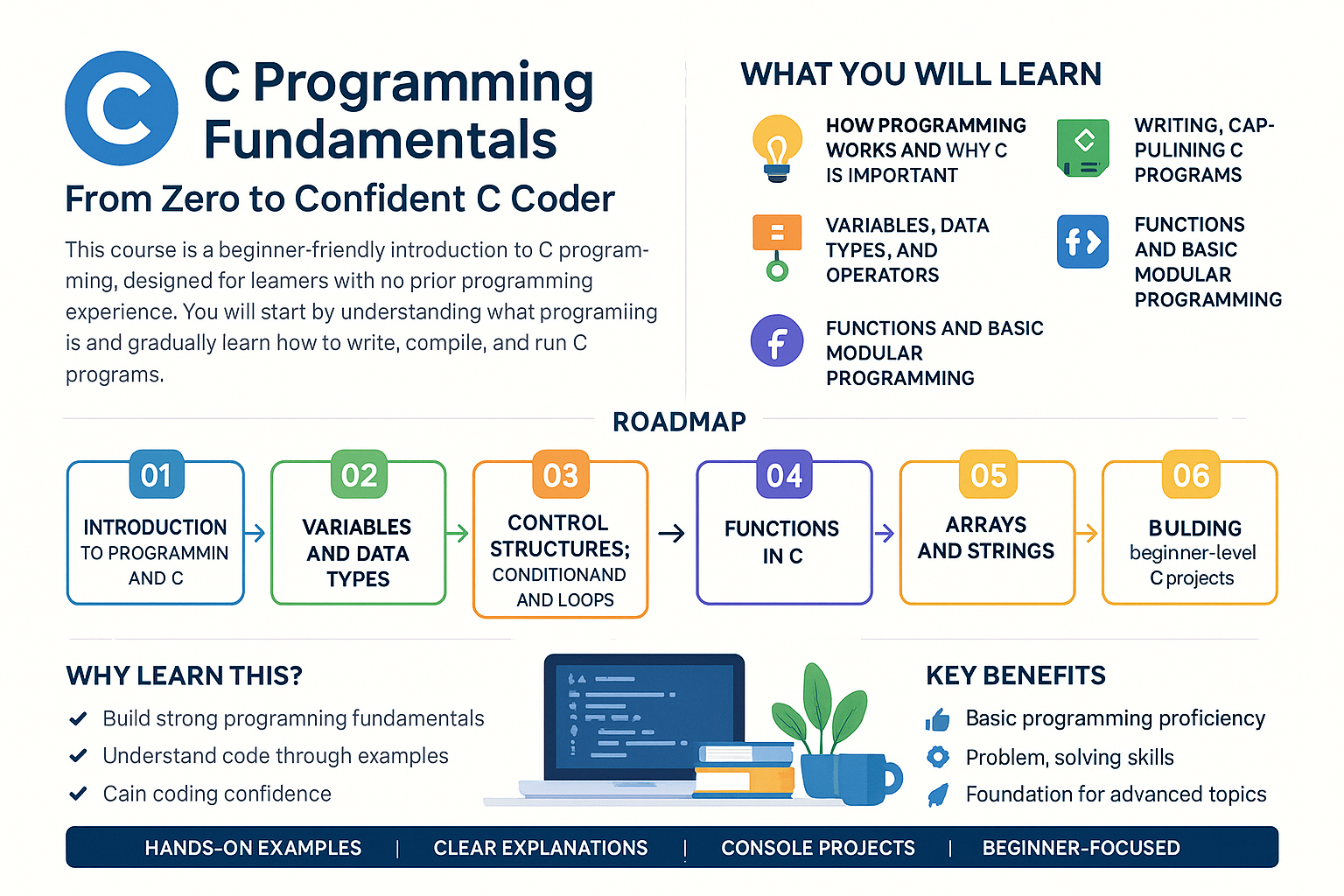
Introduction
In this lesson, we will explore the history of the C programming language, delving into its origins, key contributors to its development, major milestones in its evolution, and its profound influence on modern programming languages. By the end of this lesson, you will appreciate C's crucial role in both system and application programming.
Origins of the C Programming Language
The C programming language was developed in the early 1970s at Bell Labs, primarily by Dennis Ritchie as an evolution of the earlier B programming language, which itself was based on BCPL (Basic Combined Programming Language). The primary goal was to create a language that could improve upon the productivity and efficiency of programming tasks.
In 1972, Ritchie and his colleagues implemented C on the PDP-11 (a series of 16-bit computers), which became particularly influential in the language's initial growth and adaptation. The combination of its low-level access to memory, straightforward syntax, and powerful control structures helped C to thrive, paving the way for its usage in system programming, compilers, and more.
Key Contributors to C's Development
Throughout its development, several key figures contributed to the evolution of C, including:
- Brian Kernighan: Co-creator of the C programming language along with Ritchie; he also co-authored the influential book "The C Programming Language" (often referred to as "K&R").
- Dennis Ritchie: In addition to his role in C's development, his contributions to the UNIX operating system were pivotal in popularizing C.
- Thomas McMahon: One of the programmers instrumental in developing the first C compiler.
Major Milestones in C's Evolution
The development of C has undergone significant milestones since its inception:
- 1978: The publication of "The C Programming Language" by Kernighan and Ritchie solidified C's place in computer science. This book is still widely referenced today.
- 1983: The ANSI C project was initiated to standardize the language, culminating in the 1989 ANSI C standard (also known as C89 or C90).
- 1999: The C standard was revised to C99, introducing features such as new data types and inline functions.
- 2011: The C11 standard was published, adding multi-threading capabilities and improved support for Unicode.
These milestones showcase not only the language's growth but also its adaptability to changing technologies.
C's Influence on Modern Programming Languages
C has had a profound influence on many modern programming languages. Languages such as C++, Java, C#, and Objective-C are either based on C or borrow significantly from its syntax and concepts. For instance:
- C++ introduced object-oriented programming features while maintaining compatibility with C.
- Java adopted C's syntax but added features like garbage collection and a platform-independent runtime environment.
Example: C Code Snippet
Here’s a simple C program that demonstrates basic C syntax with input/output operations:
#include <stdio.h>

int main() {
    printf("Hello, World!\n");
    return 0;
}
Output:
Hello, World!
This program prints "Hello, World!" to the console. As seen in the code, C's syntax is structured yet straightforward, consisting of includes, declarations, and a main function.
C's Role in System and Application Programming
C has established itself as the dominant language for system programming and continues to be integral in the development of operating systems (notably UNIX), embedded systems, and high-performance applications. This is largely due to its efficiency and direct access to hardware resources, making it suitable for low-level programming tasks.
For example, many parts of the Linux operating system are written in C because of its ability to interact closely with system hardware, which is essential for the operating system's performance and efficiency.
Another Example: Simple Calculator
Below is an example of a simple calculator program in C:
#include <stdio.h>

int main() {
    int num1, num2, sum;
    printf("Enter two integers: ");
    scanf("%d %d", &num1, &num2);
    sum = num1 + num2;
    printf("Sum: %d\n", sum);
    return 0;
}
Output:
Enter two integers: 5 7
Sum: 12
This program takes two integers as input and returns their sum, demonstrating C's effective handling of user input and computation.
Summary / Key Takeaways
In this lesson on the History of C Programming Language, you have learned:
- Origins: The C programming language originated in the early 1970s at Bell Labs.
- Key Contributors: Dennis Ritchie and Brian Kernighan were pivotal in C's development and popularization.
- Major Milestones: Key milestones include the publication of the K&R book, ANSI standardization, and revisions in C99 and C11.
- Influence: C has influenced many modern languages like C++, Java, and C#.
- Role in Programming: C is essential for system and application programming due to its efficiency and direct hardware access.
Understanding the history and evolution of the C programming language provides a solid foundation for further exploration and mastery of programming concepts using C.