Introduction
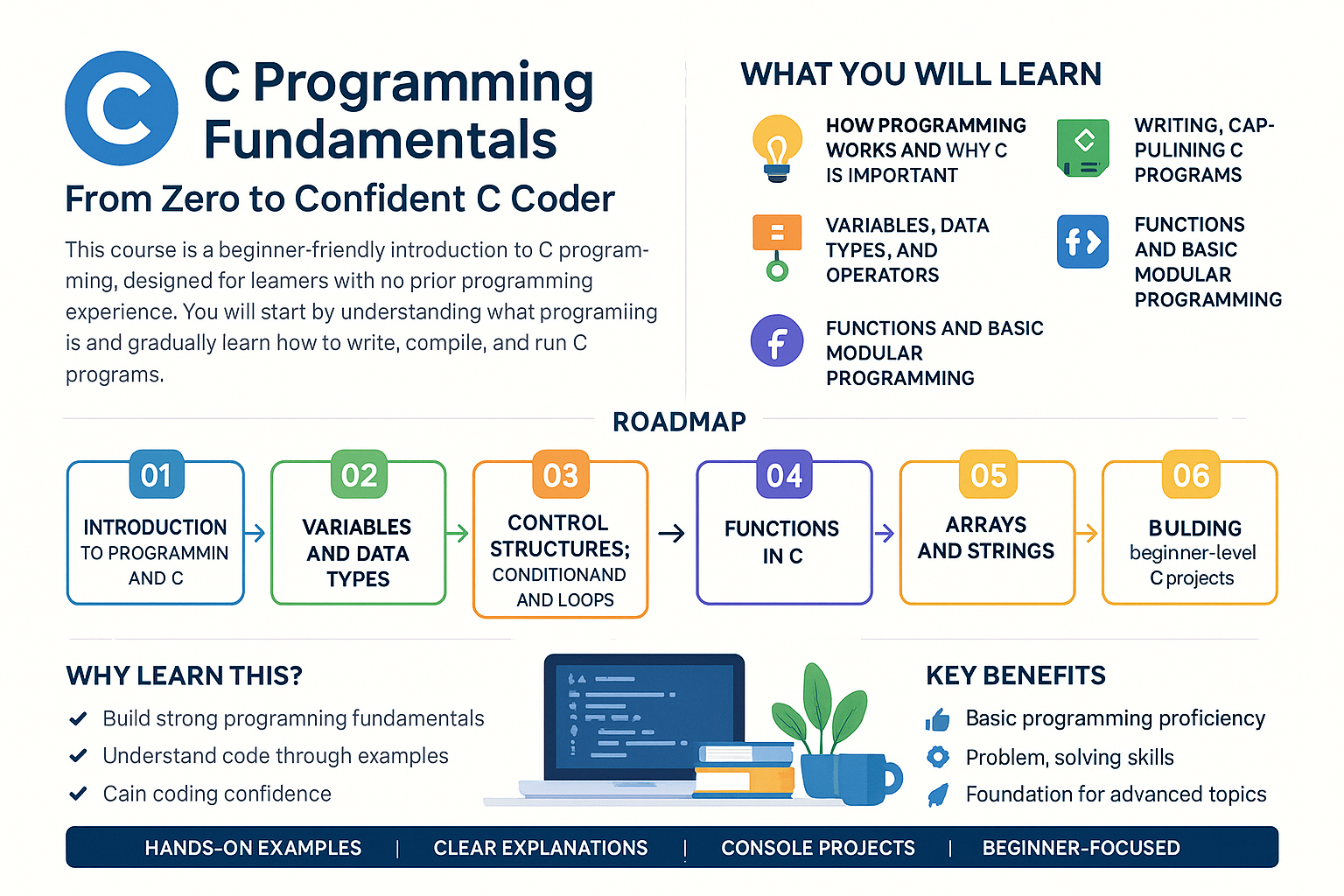
In this lesson, we will delve into the fundamental syntax and structure of the C programming language, building upon the foundation laid in previous lessons. You will learn to identify the basic components of a C program structure, write your first simple program, understand syntax rules for variables and data types, recognize and utilize operators, and implement proper program organization using functions. By the end of this lesson, you will feel more confident in your coding abilities in C.
Basic Components of C Program Structure
A C program is comprised of various components that work together to form a cohesive unit. Here are the key elements:
- Preprocessor Directives: These are lines that begin with
#and are used to include libraries and define constants. The most common directive is#include <stdio.h>, which allows us to use standard input/output functions. - Main Function: Every C program must have a
mainfunction. It is the starting point for execution. The syntax is:int main() { // code return 0; } - Statements: These are the individual instructions that are executed; for example, variable declarations, function calls, and control flow statements.
Writing Your First Simple C Program
Let’s take what we've learned so far and write a simple C program that outputs a greeting message to the console. This serves as a practical illustration of the program structure.
#include <stdio.h>

int main() {
    printf("Hello, World!\n");
    return 0;
}
This program does the following:
- Includes the standard input/output library.
- Defines the
mainfunction where program execution begins. - Uses the
printffunction to output text to the console. - Returns
0to indicate the program finished successfully.
Output:
Hello, World!
Syntax Rules for Variables and Data Types
C offers various data types to handle different kinds of data. Here are some primary datatypes:
- int: Used for integers (e.g.,
int age = 30;). - float: Used for floating-point numbers (e.g.,
float height = 5.9;). - char: Used for single characters (e.g.,
char grade = 'A';).
Variables must be declared before they are used, defining both type and name. The syntax follows:
int myVariable;
float myFloat;
char myChar;
Make sure to follow naming conventions – use descriptive names and avoid starting with a number or using special characters (except _).
Recognizing and Utilizing Operators in C Programming
Operators are symbols that perform operations on variables and values. Commonly used operators in C include:
- Arithmetic Operators:
+,-,*,/for mathematical calculations. - Relational Operators:
==,!=,>,<to compare values. - Logical Operators:
&&,||,!to combine conditions.
Here's a small example demonstrating arithmetic operations:
#include <stdio.h>

int main() {
    int a = 10;
    int b = 20;
    int sum = a + b;
    printf("Sum: %d\n", sum);
    return 0;
}
Output:
Sum: 30
Implementing Proper Program Organization with Functions
Functions in C allow for better organization and reusability of code. A function is defined as follows:
return_type function_name(parameters) {
    // function body
    return value;
}
Here’s an example of a simple function that calculates the square of a number:
#include <stdio.h>

int square(int x) {
    return x * x;
}

int main() {
    int number = 5;
    printf("Square: %d\n", square(number));
    return 0;
}
Output:
Square: 25
Summary / Key Takeaways
In this lesson, you have learned the following concepts essential for mastering C programming:
- C Program Structure: Key components such as preprocessor directives, main function, and statements.
- Writing Simple Programs: How to create, compile, and run a basic C program.
- Variables and Data Types: Understanding different data types and syntax for declaring variables.
- Utilizing Operators: The importance of arithmetic, relational, and logical operators in C.
- Function Organization: How to define and use functions for better code organization and reusability.