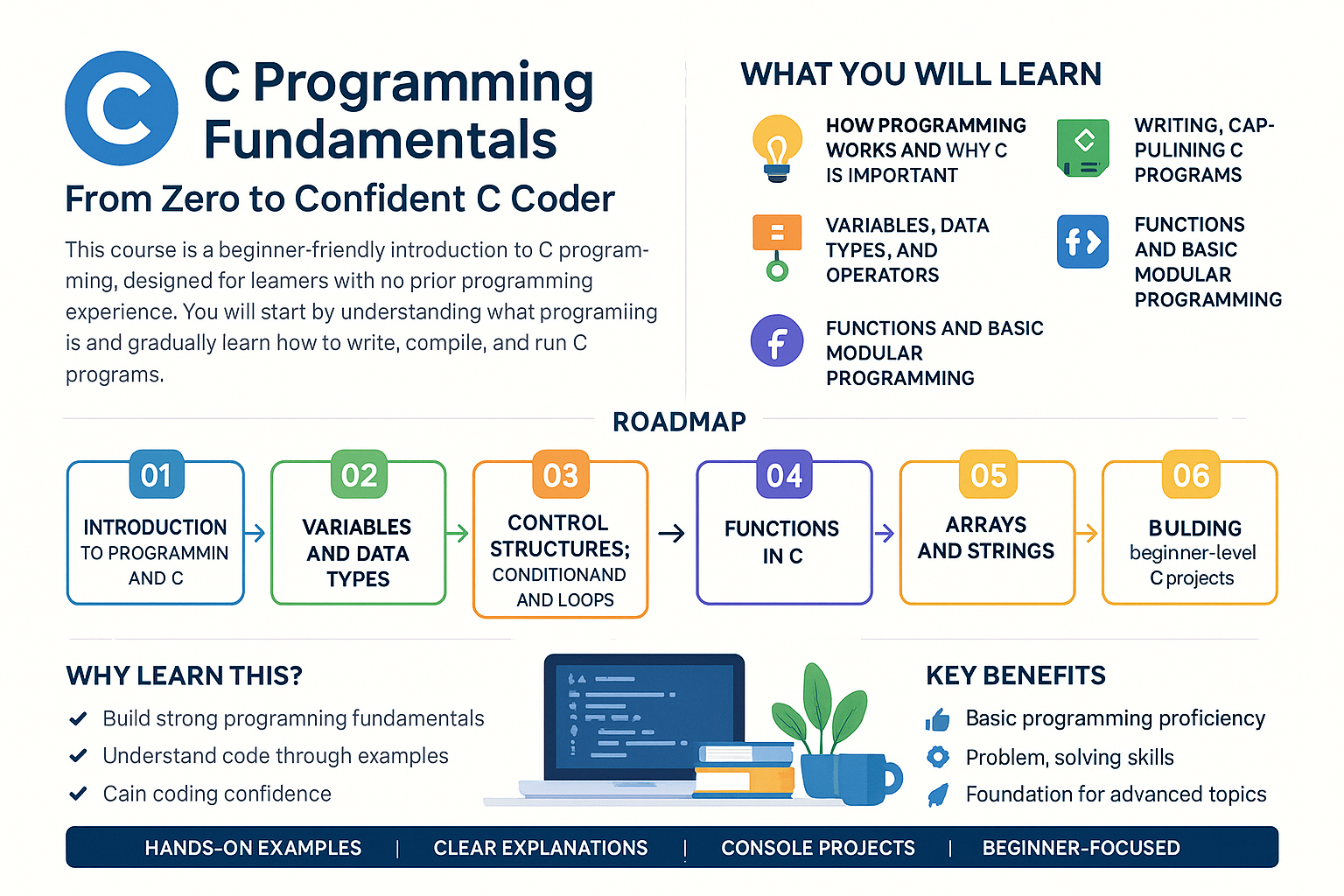
Introduction
In this lesson, we dive into the foundational concepts of declaring and initializing variables in C programming. Building on the understanding of variables and data types from previous lessons, we will enhance your skills to effectively use variables in your C programs. You will learn the correct syntax for variable declaration, explore the various data types available in C, master initialization techniques, and understand best practices for naming your variables.
Understanding the Role of Variables in C Programming
Variables serve as placeholders for data that can change during program execution. They enable you to store and manipulate a range of values. In C programming, properly declaring and initializing these variables is crucial for creating efficient and error-free code.
How to Declare Variables with Correct Syntax
Declaring a variable in C involves specifying the data type followed by the variable name. The syntax is as follows:
<data_type> <variable_name>;
For example:
int age;
float salary;
char grade;
Keep in mind that variable declarations must occur before they are used in your code to avoid compilation errors.
Exploring Different Data Types Available in C
As covered in previous lessons, C supports several fundamental data types. Here’s a quick refresher on some common data types:
- int: Represents integer values (e.g.,
int count = 10;) - float: Represents single-precision floating-point values (e.g.,
float pi = 3.14;) - double: Represents double-precision floating-point values (e.g.,
double e = 2.71828;) - char: Represents a single character (e.g.,
char letter = 'A';)
Knowing when to use each data type allows for optimized memory usage and efficient coding practices.
Master Variable Initialization Techniques for Efficient Coding
Initialization involves assigning an initial value to a variable at the time of declaration. It can be done in various ways:
- Direct Initialization: Assign a value directly when declaring the variable:
int age = 25; float height = 5.9; - Using Expressions: Variables can be initialized using expressions:
int a = 5; int b = a + 10; // b is initialized to 15 - Dynamic Initialization: This is done during runtime, depending on user input or other computations:
int number;
printf("Enter a number: ");
scanf("%d", &number);
When initializing variables, ensure to abide by the rules of the data type to avoid type mismatches.
Recognizing Best Practices for Naming Variables
Effective variable naming conventions play a significant role in improving code readability and maintainability. Here are some best practices to consider:
- Descriptive Names: Use clear and descriptive names that convey the purpose of the variable (e.g.,
totalCost,userAge). - Use CamelCase or snake_case: Follow a consistent naming convention throughout your code—either CamelCase (
totalCost) or snake_case (total_cost). - Avoid Reserved Words: Never use keywords defined by the C language as variable names (e.g.,
int,float). - Keep it Concise: While descriptive, variable names should also be concise to avoid cluttered code.
Practical Example: Variable Declaration and Initialization
Here’s a simple C program that demonstrates variable declaration, initialization, and naming best practices:
#include <stdio.h>

int main() {
    int userAge = 30;
    float userHeight = 5.8;
    char userGrade = 'B';

    printf("User Age: %d\n", userAge);
    printf("User Height: %.1f\n", userHeight);
    printf("User Grade: %c\n", userGrade);

    return 0;
}
Explanation of the Program
- In this program, we declare three variables:
userAge,userHeight, anduserGradewith typesint,float, andchar, respectively. - Each variable is initialized with an appropriate value at the time of declaration.
- The program outputs the values of these variables using
printf(), demonstrating how variables hold and present data in C programming.
Expected Output
User Age: 30
User Height: 5.8
User Grade: B
Summary / Key Takeaways
In this lesson on Declaring and Initializing Variables, you have learned:
- Role of Variables: Variables hold data that can change during program execution.
- Declaration Syntax: Variable declaration follows the format
<data_type> <variable_name>;. - Data Types: C programming supports various data types, including
int,float,double, andchar. - Initialization Techniques: You can initialize variables directly, using expressions, or dynamically during runtime.
- Best Practices for Naming: Use descriptive names that avoid reserved keywords, and maintain a consistent naming convention.
By mastering these concepts, you are well on your way to becoming a confident C coder!