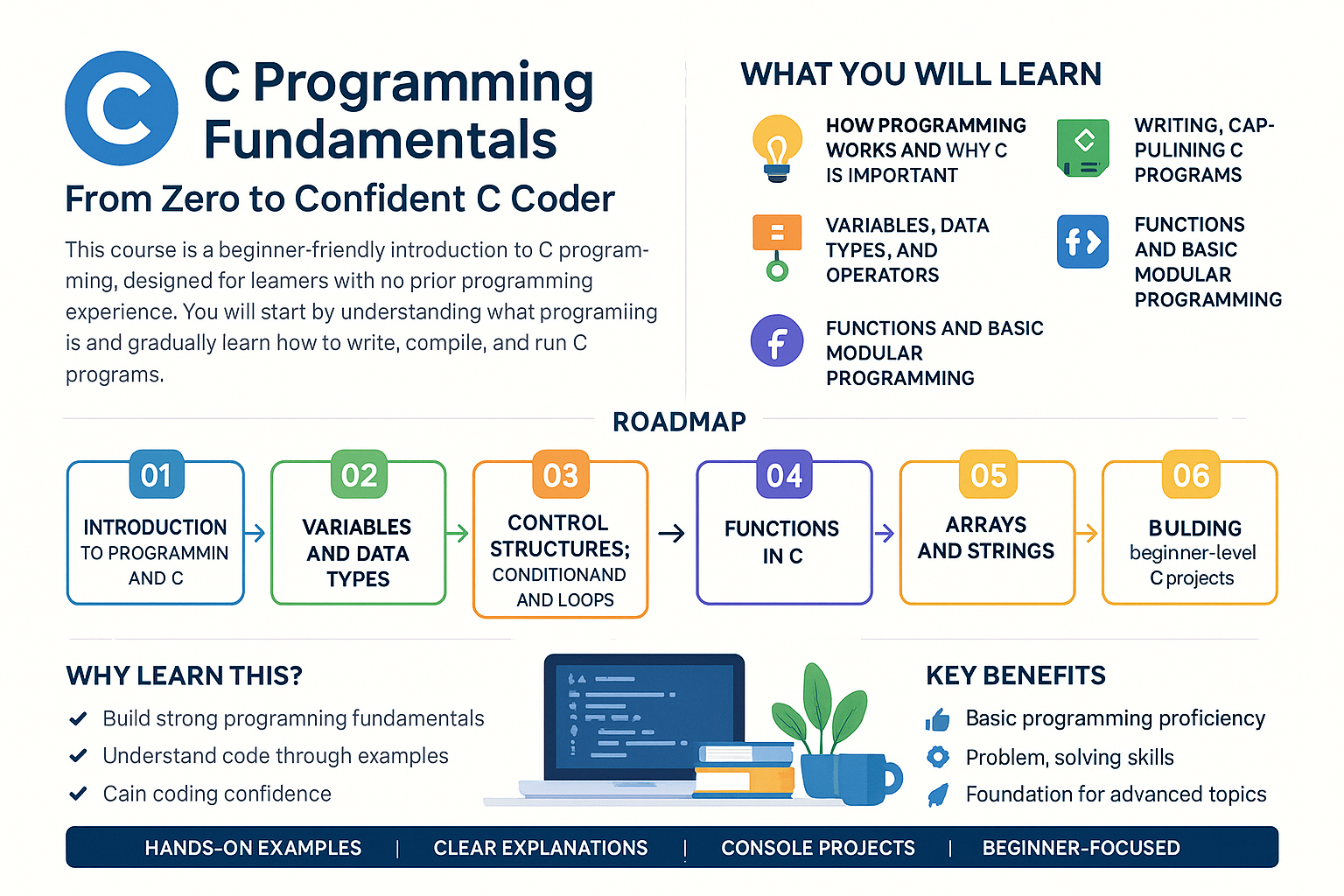
Introduction
You now have a solid foundation in C and have already built and tested complete programs. This lesson focuses on what comes next: which advanced C topics to explore, how to write more professional-quality code, how to grow through real projects and collaboration, and how to leverage your C skills when learning other languages.
1. Key Advanced C Concepts to Go Deeper
At this stage, you should move beyond syntax and focus on deeper language and system-level concepts.
1.1 Advanced Language Features to Study
These are important directions for further learning:
- Function pointers and callbacks (e.g., for event handlers, strategy selection)
- Variadic functions (like
printf) using<stdarg.h> - Advanced
constcorrectness (const pointers vs pointer-to-const) volatilekeyword (embedded / concurrent contexts)- Inline functions and macros trade-offs
- Strict aliasing and undefined behavior rules
- Threading and concurrency with POSIX threads (
pthread) or platform equivalents
Example: Function Pointers for Flexible Behavior
#include <stdio.h>

int add(int a, int b) { return a + b; }
int mul(int a, int b) { return a * b; }

int compute(int x, int y, int (*op)(int, int)) {
    return op(x, y); // call the selected operation
}

int main(void) {
    int a = 6, b = 7;

    int sum = compute(a, b, add);
    int product = compute(a, b, mul);

    printf("sum = %d\n", sum);
    printf("product = %d\n", product);
    return 0;
}
// Output:
// sum = 13
// product = 42
Explanation: The compute function accepts a function pointer so you can choose at runtime which operation to apply. This pattern appears in callbacks, sorting with custom comparison functions, and state machines.
2. Best Practices for Efficient, Maintainable C Code
You already know basic best practices; now refine them toward production-quality style.
2.1 Design and Interface Practices
- Design clear interfaces: keep
.hfiles as small, stable contracts. - Hide implementation details in
.cfiles (opaque structs, private helpers). - Prefer small, focused functions; avoid long functions with mixed responsibilities.
- Use
constaggressively to express intent and prevent accidental mutation.
2.2 Error Handling and Resource Management
- Return detailed error codes, not just
0/-1. - Follow a consistent cleanup pattern to avoid leaks.
#include <stdio.h>
#include <stdlib.h>

int process_file(const char *path) {
    FILE *f = NULL;
    int status = 0; // 0 = success, non-zero = error

    f = fopen(path, "r");
    if (!f) {
        return 1; // open error
    }

    // ... process data, check for errors, set status accordingly ...

cleanup:
    if (f) fclose(f);
    return status;
}

int main(void) {
    int rc = process_file("data.txt");
    if (rc != 0) {
        fprintf(stderr, "Failed to process file, code=%d\n", rc);
        return EXIT_FAILURE;
    }
    return EXIT_SUCCESS;
}
// Output (example if file missing):
// Failed to process file, code=1
Explanation: The cleanup label centralizes resource release, which scales well when you have multiple allocations and error paths.
2.3 Performance with Clarity
- Optimize algorithms first, micro-optimize only when profiling shows a need.
- Avoid unnecessary copies; pass large structs via pointers when appropriate.
- Use
restrict(where supported) to hint that pointers do not alias, but only when you are sure.
3. Resources for Continuous C Improvement
3.1 Essential Reading
Look up and study:
- ISO C standard drafts (freely available drafts for C11/C17) – for exact rules.
- Books focused on systems programming in C, not just syntax.
- High-quality open-source C projects (e.g., small libraries, tools, or parts of well-known projects) to see real-world style.
3.2 Practice and Feedback
- Solve problems on coding platforms using C.
- Contribute tiny fixes to open-source C projects: documentation, spelling, or minor bug fixes.
- Ask for code reviews from more experienced C developers.
4. Preparing for C Project Development and Collaboration
You’ve already organized projects and used basic version control. The next step is to work like a team developer.
4.1 Coding Standards and Review
- Adopt or adapt an existing style guide (e.g., Linux kernel style, Google C style) and stick to it.
- Use automated formatting (e.g.,
clang-format) to avoid style debates.
4.2 Practical Collaboration Workflow
- Create issues or tickets describing tasks and bugs.
- Branch per feature/bug (e.g.,
feature/logging,bugfix/overflow). - Commit frequently with meaningful messages describing why changes were made.
- Open merge/pull requests and request reviews.
Example: Simple Modular Design Pattern
// log.h
#ifndef LOG_H
#define LOG_H

void log_info(const char *msg);
void log_error(const char *msg);

#endif
// log.c
#include <stdio.h>
#include "log.h"

void log_info(const char *msg) {
    printf("[INFO] %s\n", msg);
}

void log_error(const char *msg) {
    fprintf(stderr, "[ERROR] %s\n", msg);
}
// main.c
#include "log.h"

int main(void) {
    log_info("Application started");
    log_error("An example error");
    return 0;
}
// Output:
// [INFO] Application started
// [ERROR] An example error
Explanation: This tiny module shows separation of interface and implementation, making collaboration easier: one person can work on logging, others use it via log.h.
5. Transitioning from C to Other Languages
Your C background gives you a strong base to learn many languages more quickly.
5.1 Mapping C Knowledge to Other Languages
- C → C++: reuse C syntax and memory understanding; learn RAII, classes, templates, and the C++ standard library to reduce manual memory handling.
- C → Java / C#: control structures and expressions feel familiar; instead of manual memory, focus on object-oriented design, garbage collection, and rich standard libraries.
- C → Python / JavaScript: concepts like variables, functions, modules, and data structures carry over; you get dynamic typing and powerful built-ins, but at a higher abstraction level.
5.2 Practical Transition Strategies
- Re-implement a small C project in another language.
- Compare error handling patterns (return codes vs exceptions).
- Identify what the higher-level language abstracts away (e.g., pointers, manual allocation) and what it expects you to manage (e.g., types, concurrency models).
Summary / Key Takeaways
In this lesson Preparing for Further Learning in C and Beyond, you have learned:
- Key advanced C areas to explore next, including function pointers, variadic functions, const correctness, and concurrency-related keywords.
- Design and coding practices that improve maintainability, such as clear interfaces, small focused functions, and disciplined error handling.
- Resource strategies for improvement, including reading standards and high-quality codebases, and seeking feedback through code review.
- Collaboration techniques suited to C projects, from modular design with headers and source files to branch-based workflows and automated formatting.
- Robust resource management patterns that scale to larger programs, especially centralized cleanup and explicit error codes.
- How your C knowledge transfers to languages like C++, Java, C#, Python, and JavaScript, and what new abstractions to focus on when transitioning.
- Practical next steps such as contributing to open source, creating reusable modules, and rewriting small C projects in other languages to deepen understanding.