Introduction
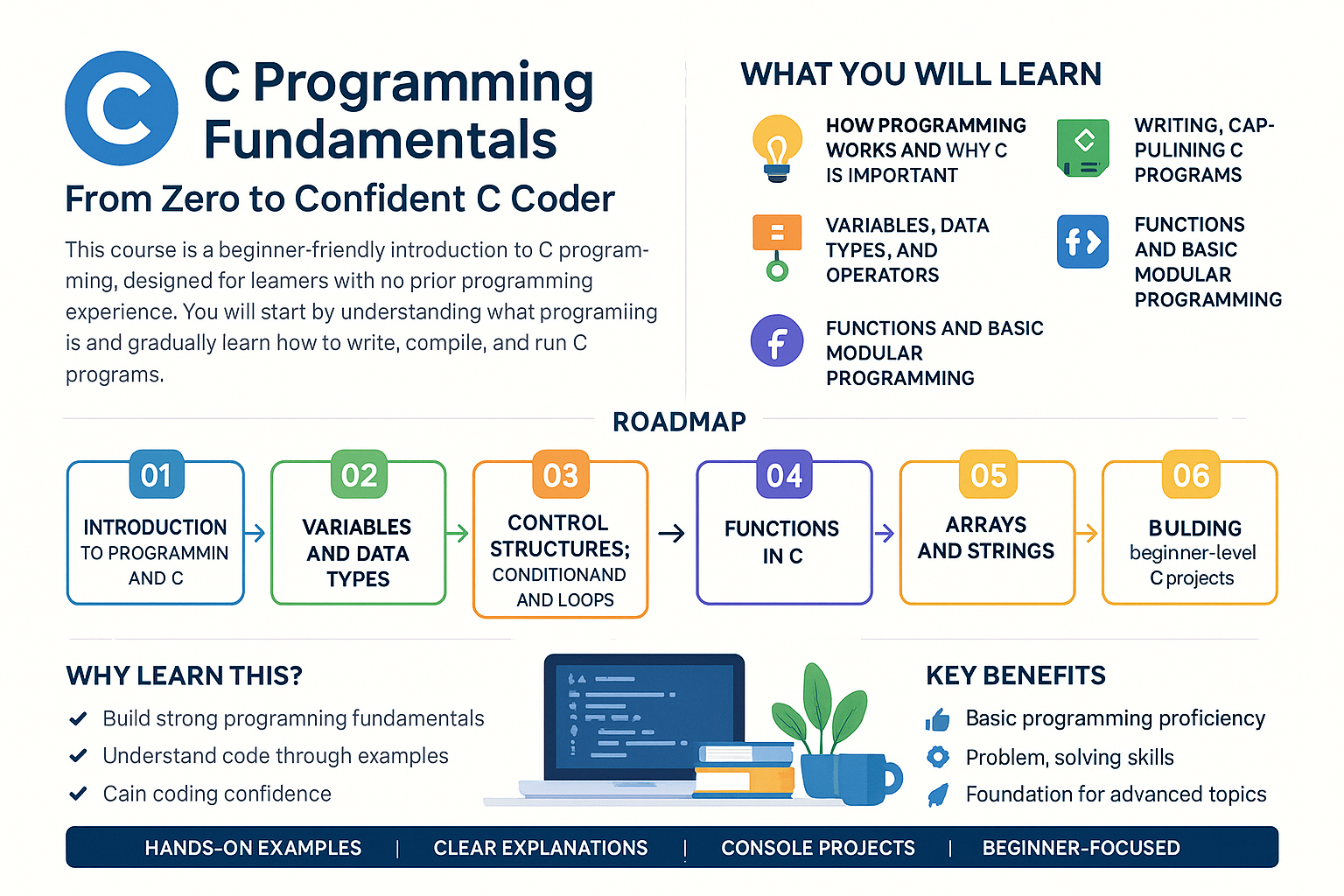
In this lesson, we will delve into the fundamentals of creating modular programs in C using functions. Functions play a critical role in organizing code, promoting reuse, and enhancing readability. We will explore how to effectively define and declare functions, implement parameters and return values, utilize function prototypes, and understand the scope and lifetime of variables. Additionally, we'll discuss best practices for debugging and testing our functions to ensure a reliable program.
Defining and Declaring Functions
Defining a function involves specifying the functionality it will perform. In C, we can define functions with the following general syntax:
return_type function_name(parameter_list) {
    // function body
}
Example: Simple Addition Function
Let’s define a simple function that adds two integers.
#include <stdio.h>

int add(int a, int b) {
    return a + b;
}

int main() {
    int sum = add(5, 3);
    printf("Sum: %d\n", sum);
    return 0;
}
Output:
Sum: 8
Explanation
In this example, the add function takes two parameters, a and b, and returns their sum. The main function calls add, and we display the result using printf.
Function Parameters and Return Values
Parameters allow functions to accept inputs, enabling more dynamic and modular code. The return value is essential for providing output from a function back to the caller:
float calculate_area(float radius) {
    return 3.14 * radius * radius;
}
Example: Calculating Area
Let's create a function to calculate the area of a circle based on its radius.
#include <stdio.h>

float calculate_area(float radius) {
    return 3.14 * radius * radius;
}

int main() {
    float area = calculate_area(5.0);
    printf("Area: %.2f\n", area);
    return 0;
}
Output:
Area: 78.50
Explanation
The calculate_area function takes a float parameter for the radius and returns the area calculated using the formula. We call this function in the main function and print the area.
Utilizing Function Prototypes
Function prototypes allow for better organization and readability of code. Before using a function, we can declare its prototype:
int multiply(int, int);
This declaration states that there exists a function named multiply that takes two int parameters and returns an int. The prototype should be placed at the beginning of the program or before its usage to avoid errors.
Understanding Scope and Lifetime of Variables
In C, the scope refers to the visibility of variables, whereas lifetime refers to how long they exist during program execution.
- Local variables are defined within a function, and their scope is limited to that function.
- Global variables, on the other hand, are declared outside all functions, making them accessible from anywhere within the program.
Example: Scope
#include <stdio.h>

int globalVar = 10; // Global variable

void display() {
    int localVar = 5; // Local variable
    printf("Local Variable: %d\n", localVar);
    printf("Global Variable: %d\n", globalVar);
}

int main() {
    display();
    return 0;
}
Output:
Local Variable: 5
Global Variable: 10
Explanation
The localVar is defined within the display function, making it inaccessible outside, while globalVar is accessible in both main and display functions.
Debugging and Testing Functions
Testing functions is crucial to ensure that they perform as expected. When debugging, consider the following:
- Use print statements to examine variable values.
- Check for edge cases (e.g., empty inputs, maximum values).
- Utilize debugging tools available in your IDE or command-line tools to trace execution.
Example: Error Checking
#include <stdio.h>

int safe_divide(int a, int b) {
    if (b == 0) {
        printf("Error: Division by zero!\n");
        return 0;
    }
    return a / b;
}

int main() {
    int result = safe_divide(10, 0);
    printf("Result: %d\n", result);
    return 0;
}
Output:
Error: Division by zero!
Result: 0
Explanation
In the safe_divide function, we check for division by zero to prevent runtime errors and handle this gracefully by printing an error message.
Summary / Key Takeaways
In this lesson on creating modular programs with functions in C, you have learned:
- Defining and declaring: Functions are crucial for organizing code.
- Parameters and return values: Enhance the modularity and dynamism of functions.
- Function prototypes: Improve code readability and organization.
- Scope and lifetime: Understand how local and global variables function.
- Debugging functions: Essential techniques and best practices for ensuring code reliability.