The SQL Interview Questions course is designed to help beginners master the art of answering interview questions related to SQL. This course covers a broad range of questions, from conceptual understanding to scenario-based and practical problem-solving inquiries. By focusing on real-world interview techniques used by top technology companies, this course prepares learners to confidently tackle SQL-related questions. Through comprehensive modules, learners will gain the skills needed to excel in technical interviews and stand out in the competitive field of data engineering. Make sure you use the Same SQL tables to explain all the interview questions
AIStudyLabs
SQL Interview Questions
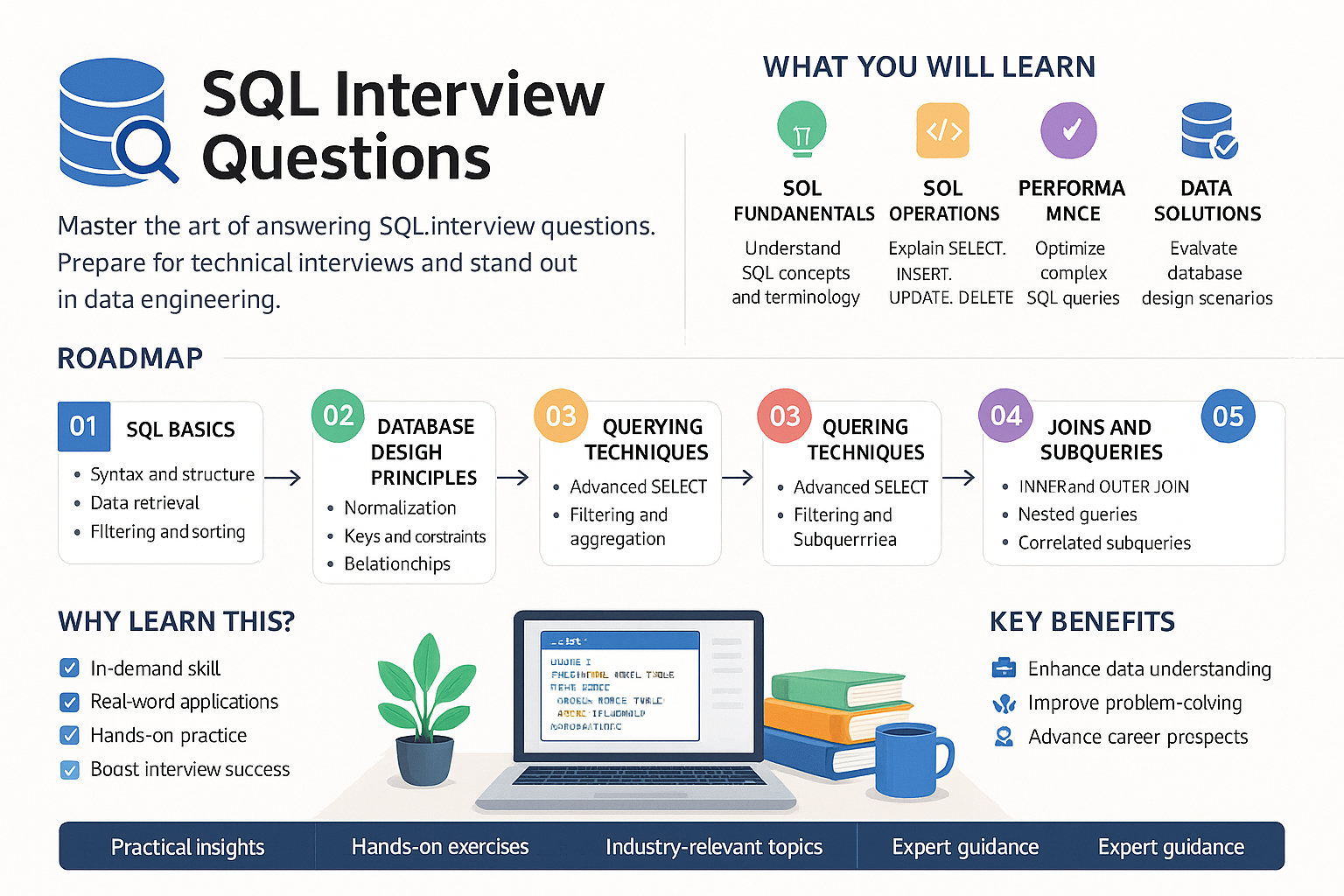
What You'll Learn
- Understand fundamental SQL concepts and terminology.
- Explain key SQL operations such as SELECT, INSERT, UPDATE, and DELETE.
- Analyze complex SQL queries and optimize them for better performance.
- Evaluate different database design scenarios and choose appropriate solutions.
- Apply SQL techniques to solve real-world data problems.
- Identify common pitfalls in SQL queries and how to avoid them.
- Compare SQL and NoSQL databases in terms of structure and use cases.
- Solve scenario-based SQL questions with confidence.
- Understand the role of SQL in data engineering and analytics.
- Answer SQL interview questions with clear and concise explanations.
- Demonstrate practical SQL skills through hands-on exercises.
SQL Basics
- What is a primary key in SQL, and why is it important?
- Explain the differences between the SQL commands SELECT, INSERT, UPDATE, and DELETE.
- How do you use SQL syntax to create an index and what are its benefits?
- What is normalization in SQL and why is it important in database design?
- How do SQL JOINS work and what is the difference between INNER JOIN, LEFT JOIN, and RIGHT JOIN?
- What is a subquery and how can you utilize it within a SQL statement?
- Could you explain what a stored procedure is in SQL and give a basic example of how it is created and used?
- How does the GROUP BY clause function in SQL, and when is it typically used?
- What is the difference between UNION and UNION ALL SQL operators?
Database Design Principles
- What is normalization in database design, and why is it important?
- What are primary keys and foreign keys, and how do they relate to database integrity?
- Explain the difference between one-to-one, one-to-many, and many-to-many relationships in database design.
- What is a composite key, and when would you use it in a database?
- How would you implement a many-to-many relationship using SQL tables with primary and foreign keys?
- What is denormalization, and why might it be used in a database?
- How can indexing enhance database performance, and what are some potential downsides?
- What are database constraints, and how do they enforce data integrity?
- Can you explain the role of a junction table in managing many-to-many relationships and give a real-world example?
Querying Techniques
- What is the purpose of the WHERE clause in SQL, and how is it different from the HAVING clause?
- Can you explain the ORDER BY clause with an example of sorting data in both ascending and descending orders?
- What is the GROUP BY clause, and how does it work with aggregate functions like COUNT, SUM, and AVG?
- Explain how the INNER JOIN operator works in SQL. Provide an example of a query using INNER JOIN between two tables.
- How can the LEFT JOIN operator be used in SQL? Illustrate with a query example.
- What is a CROSS JOIN in SQL, and in what scenarios is it typically used? Provide an example.
- Describe the concept and process of using the UNION operator in SQL. Can you provide an example?
- How do you use SQL's LIKE operator for pattern matching? Provide examples for different scenarios.
- Explain the use of NULL in SQL and how to check for NULL values using IS NULL and IS NOT NULL.
Joins and Subqueries
- What is an INNER JOIN in SQL, and when would you use it?
- Explain the usage and difference between LEFT JOIN and RIGHT JOIN with an example.
- What is a FULL OUTER JOIN, and how does it compare to other joins?
- Describe the purpose of a CROSS JOIN and provide an example of when it might be used.
- Explain how subqueries work in SQL and differentiate between correlated and non-correlated subqueries with examples.
- What are the advantages of using subqueries over joins, and in what scenarios are they particularly beneficial?
- Can you explain the difference between a scalar subquery and a row subquery and provide an example?
- How can you improve performance when using subqueries in SQL?
- What role do nested subqueries play in hierarchical data models, and how can you effectively work with them?
- How can Common Table Expressions (CTEs) be used alongside joins and subqueries to improve SQL query efficiency and readability?
SQL Functions and Operators
- What is the purpose of the CONCAT function in SQL, and how can it be used to combine first and last names in a table?
- How do you extract the day, month, and year from a date column in SQL using built-in functions?
- Explain the use of comparison operators in SQL with a practical example.
- What is the role of the COALESCE function, and how would you use it to handle NULL values in SQL?
- Demonstrate how logical operators are used in SQL to create complex WHERE clauses.
- How can the CASE statement be used to create conditional logic in SQL queries?
- Describe how arithmetic operators are functionally utilized in SQL queries and their significance.
- What are aggregate functions in SQL, and how would you use them to compute the average price in a products table?
- Illustrate how string functions such as SUBSTRING and LENGTH can be employed to transform and analyze text data in SQL.
- Explain how you can use the ISNULL function to manage NULL values in a column and its importance in data processing.
Data Manipulation Language (DML)
- What is the role of the INSERT statement in SQL and how would you use it to add new data to a table?
- How would you update existing data in a table using SQL, and what precautions should you take?
- Discuss the DELETE statement in SQL and show how you can remove data from a table while maintaining database integrity.
- What are transaction controls in SQL, and why are they important in executing DML operations?
- Explain how you would handle concurrent DML operations in SQL to ensure consistency and accuracy across transactions.
- When might you use the MERGE statement in SQL, and how does it relate to other DML operations?
- How do indexes impact DML operations in SQL databases and how should they be managed?
- Explain how foreign key constraints affect DML operations and the strategies to manage them.
- What are some considerations for optimizing DML operations in high-traffic SQL databases?
Data Definition Language (DDL)
- What is the purpose of the CREATE command in SQL, and can you provide an example of creating a new table with it?
- How does the ALTER command differ from the CREATE command in SQL, and can you give an example of how to use ALTER to add a column to an existing table?
- What are some differences between DROP and TRUNCATE commands in SQL, particularly in their use with DDL?
- How can you use the ALTER command to modify the data type of an existing column in a table?
- Describe a scenario where the DROP TABLE command might be used, and what considerations must be taken?
- Can you explain how the CREATE TABLE command can be used with constraints, providing an example?
- How do you use the ALTER TABLE command to rename a column in an existing table?
- Why is it essential to use constraints like PRIMARY KEY and FOREIGN KEY in table creation, and how does it impact database integrity?
- What are the consequences of performing DROP on a column within a table with the ALTER TABLE command?
- Explain how to change the default value of a column in a table using the ALTER TABLE command. Why would you want to set or change a default value?
Transactions and Concurrency
- What are the ACID properties in a database transaction and why are they important?
- Explain the concept of transaction isolation levels. How do they affect concurrency, and what are their implications?
- What is a deadlock in the context of SQL transactions, and how can it be resolved?
- How can the concept of 'optimistic concurrency control' be implemented in an SQL database?
- In what situations would 'pessimistic concurrency control' be preferable over 'optimistic concurrency control'?
- Describe how SQL handles concurrency with lock-based mechanisms. What types of locks are typically used?
- What are phantom reads, and how can they be prevented?
- Describe how distributed transactions work in SQL and the challenges they pose.
- Can you explain the term 'Write Ahead Logging' (WAL) and how it helps in ensuring durability in databases?
- What is the role of 'lock escalation' in SQL databases?
Indexes and Performance Tuning
- What is an index in SQL, and how does it improve query performance?
- What are the differences between a clustered and a non-clustered index in SQL?
- How does index fragmentation occur, and what are the methods to reduce it?
- What is a covering index, and how does it differ from a standard index?
- How can you assess and identify missing or unused indexes in SQL, and why is it important to address them?
- How can you handle and optimize large-scale data operations with indexes effectively in SQL?
- How would you resolve SQL query performance issues that occur despite having well-optimized indexes in place?
- What factors can cause an index to become invalid, and how can you identify and rectify invalid indexes in SQL?
- What are filtered indexes in SQL, and when would you choose to implement them over standard indexes?
Stored Procedures and Views
- What is a view in SQL, and why would you use it?
- Explain the difference between a stored procedure and a view in SQL.
- How can stored procedures improve performance in SQL-driven applications?
- What are the limitations of using SQL views?
- Can you explain parameterized stored procedures and their advantages in SQL?
- Discuss how you can manage stored procedure permissions in SQL.
- What steps would you take to troubleshoot a failing stored procedure in SQL?
- How would you implement a change in business logic using SQL views?
- Describe how you would schedule a stored procedure to run automatically at specified intervals.
Data Retrieval Optimization
- What is an index in SQL, and how does it improve query performance?
- How does the use of `EXPLAIN` improve query optimization in SQL?
- What are the differences between a clustered index and a non-clustered index in SQL?
- Why is query rewriting important for optimization, and can you provide an example of a query that can be rewritten for better performance?
- What are SQL query hints, and when would their use be necessary for query optimization?
- How can you identify and eliminate inefficient joins in SQL queries?
- Why does using the correct data types matter for query optimization in SQL?
- What role do subqueries play in SQL query optimization, and how can they be avoided if inefficient?
- Why is it important to avoid using `SELECT *`, and how can this practice impact SQL query performance?
SQL Constraints and Integrity
- What is the purpose of the NOT NULL constraint in SQL, and how does it contribute to data integrity?
- Explain the UNIQUE constraint and how it differs from the PRIMARY KEY constraint.
- Describe the functionality of the CHECK constraint and provide an example of its application.
- How can a FOREIGN KEY constraint maintain referential integrity, and what issues does it prevent?
- How does a PRIMARY KEY constraint contribute to data integrity, and why is it essential?
- Illustrate how the DEFAULT constraint functions and its usability in database design.
- Discuss how cascading options (CASCADE, SET NULL) for FOREIGN KEY constraints affect database operations.
- Why might you choose to use a composite PRIMARY KEY and in what scenarios is this beneficial?
- Explain the significance of DEFERRABLE constraints in SQL and provide an appropriate usage case.
- How does the use of SQL constraints assist in enforcing domain integrity, and why is this advantageous?
Handling NULL Values
- What is the significance of NULL in SQL, and how is it different from an empty string or zero?
- How does the IS NULL operator work in SQL, and when should you use it?
- What is the purpose of the COALESCE function in SQL, and how is it different from ISNULL?
- How can you use COALESCE for handling multiple columns with potential NULL values?
- In what scenarios is using COALESCE preferable over a simple CASE statement for managing NULL values?
- How do you handle NULL values during JOIN operations, and why is it important?
- Explain how the IN operator behaves with NULL values and how you should alter your query when searching for NULL results.
- How do aggregate functions in SQL deal with NULL values, and how can this affect your result sets?
- When constructing SQL views, how can you ensure NULL value handling is optimized for future query performance?
- How can using CASE statements help manage complex NULL scenarios in SQL queries?
Working with Multiple Tables
- Explain the difference between INNER JOIN and LEFT JOIN with examples. When would you use each?
- What is a CROSS JOIN and how can it be used? Provide an example.
- How would you use a self-join, and what are its real-world applications?
- What are UNION and UNION ALL in SQL, and how do they differ? Can you give an example?
- Describe a scenario where a full outer join would be necessary. Provide SQL syntax for reference.
- How can subqueries involve multiple tables, and what are the benefits of using them in complex SQL operations?
- When would you use a NATURAL JOIN, and what are its limitations?
- Can you describe an example using aliases within a JOIN clause and explain their significance?
- Why is it difficult to achieve efficient query performance with nested subqueries, and how can refactoring improve this performance?
- Discuss the use of COALESCE in combining results from multiple tables with possible NULLs. Give an example.
Real-world SQL Scenarios
- How would you retrieve all customer orders along with their details, ensuring that customers with no orders are also included?
- How would you find the total number of orders placed by each customer?
- How would you find customers who have placed more than five orders?
- How do you update the order status to 'Shipped' for all orders made before 2023?
- Write a query to find duplicate customer names in the database.
- How would you identify the top 3 customers with the highest total order values?
- How can you delete orders with no associated customer records?
- Describe how you would find all orders that have been placed in the last 7 days.
- Explain how you would join multiple tables to construct a customer purchase history report, including customer details, order details, and order status.
- How would you write a query to calculate the average order value per customer?