AIStudyLabs
Learn Python Basics by Frequently Asked Questions
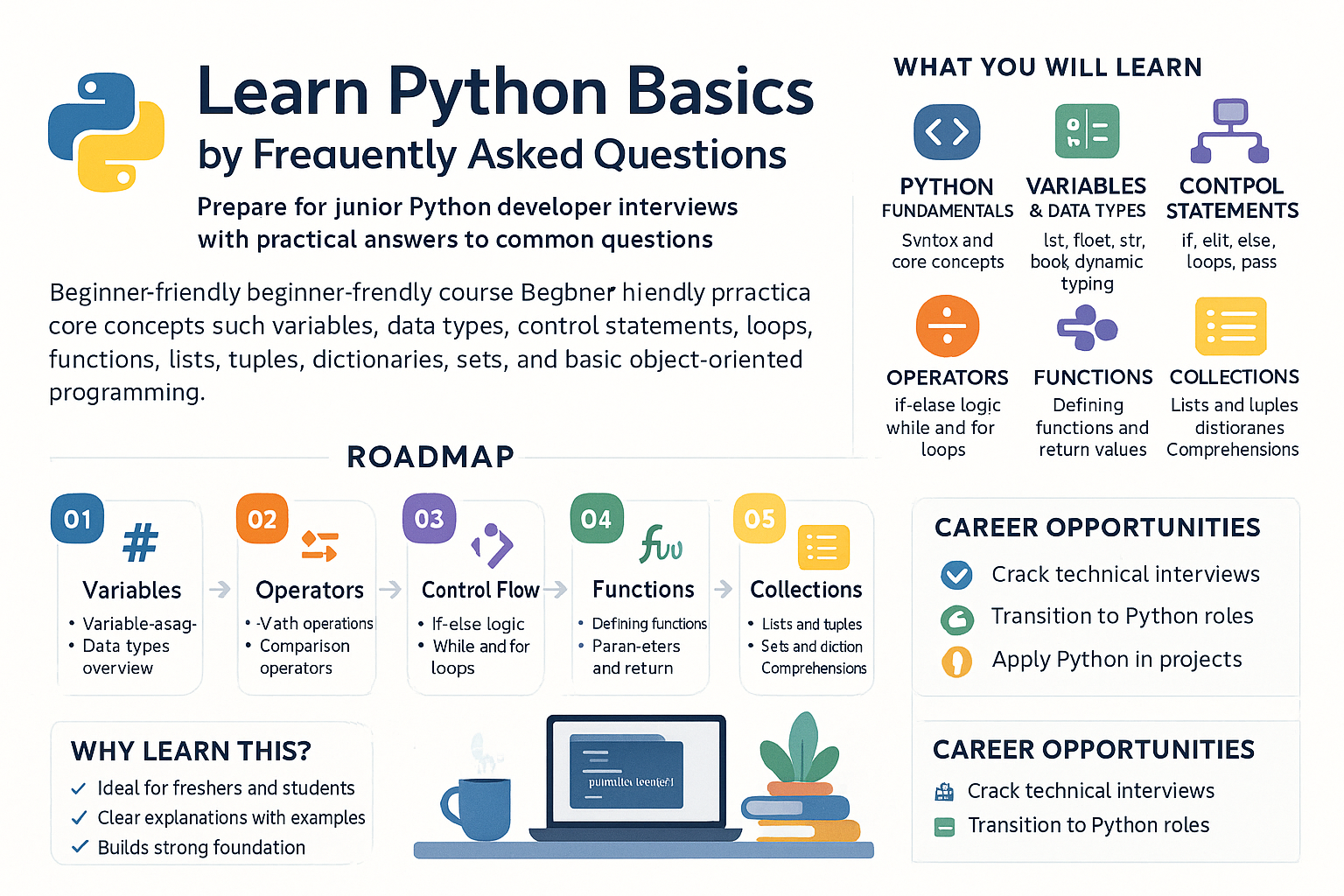
Python Basic Frequently Asked Questions is a beginner-friendly course designed to help you confidently prepare for entry-level and junior Python developer interviews. It covers core concepts such as variables, data types, control statements, loops, functions, lists, tuples, dictionaries, sets, and basic object-oriented programming.
You’ll also learn about error handling, file handling, and commonly asked coding problems. This course focuses on practical, interview-oriented explanations with clear examples, helping you understand not just the “what” but also the “why” behind each concept. Ideal for freshers, students, and developers transitioning into Python, it builds a strong foundation to crack technical interviews successfully.
What You'll Learn
- Python fundamentals and syntax
- Variables and data types (int, float, str, bool)
- Type casting and dynamic typing
- Operators (arithmetic, comparison, logical, assignment)
- Control statements (if, elif, else)
- Loops (for, while, break, continue, pass)
- Functions (definition, arguments, return values, default parameters)
- *args and **kwargs
- Recursion basics
- Lists (methods, slicing, list comprehension)
- Tuples and their differences from lists
- Sets and set operations
- Dictionaries (methods, iteration, dictionary comprehension)
- String operations and methods
- String formatting (f-strings, format method)
- Exception handling (try, except, finally, raise)
- File handling (read, write, append modes)
- Basic Object-Oriented Programming (classes, objects, init, self)
- Modules and packages
- Python built-in functions (len, range, type, isinstance, etc.)
- Virtual environments overview
- PEP 8 basics and coding best practices
- Common beginner coding problems
- Frequently asked interview theory questions
Python Basics and Syntax
- What are variables in Python, and how are they used? Can you provide examples?
- What are the different data types in Python, and how are they used?
- Explain control flow statements in Python. What are 'if', 'elif', and 'else' used for?
- Describe the different ways to handle loops in Python. Why might you use a 'for' loop instead of a 'while' loop?
- How are functions defined in Python, and what is the difference between arguments and parameters?
- How are lists different from tuples in Python, and when should you use each?
- What are dictionaries in Python, and how do they differ from lists and tuples? Provide use cases.
- Explain error handling in Python. How do exceptions fit into this, and what are a 'try-except' block's benefits?
- Describe file handling operations in Python. What are the benefits of using context managers with 'with' versus standard open/close operations?
- What is basic object-oriented programming (OOP) in Python, and how do classes enhance your ability to organize and reuse code?
Variables and Data Types
- What is a variable in Python, and how is it different from statically-typed variables in languages like Java or C?
- What are Python’s primitive data types, and how does Python manage memory for these types?
- How does Python's type-checking mechanism work, and how can you verify the data type of a variable?
- Can you explain type casting in Python with examples?
- Explain dynamic typing in Python with a practical example.
- What's the importance of the 'None' type in Python, and how is it commonly used in Python programs?
- How do you differentiate between mutable and immutable data types with examples in Python?
- What is the significance of the 'id()' function in Python, and how can it be used to understand variable behavior?
- Illustrate how Python distinguishes between values and identities in the context of variables.
- Why might you choose immutable types over mutable types in certain Python applications?
Operators
- What are the basic arithmetic operators in Python, and how do they function?
- How do comparison operators work in Python, and can you provide a practical example?
- Explain logical operators in Python with examples. How is precedence managed among them?
- What are assignment operators in Python, and how do they simplify script writing?
- Describe identity operators in Python and provide a scenario where they can be effectively utilized.
- Can you explain membership operators in Python and how they could be used in string operations?
- How do Python operators function with lists or tuples through element-wise operations?
- Can you illustrate how Python handles operator precedence with a combination of various operators?
- In Python, how are different types of operators used together in expressions to enhance readability and functionality?
Control Flow Statements
- What are conditional statements in Python, and why are they important?
- Explain how you can use nested if statements in Python.
- What is the difference between 'if' and 'elif' in Python?
- Can you use multiple 'elif' statements in Python? Provide an example.
- Explain the role of the else statement in Python's conditional structures.
- Is it possible to write Python's conditional statement in a single line? How would you use it?
- How can logical operators (and, or, not) be used in conjunction with conditional statements in Python?
- Provide an example of using a conditional statement inside a loop in Python, and explain its functionality.
- What are some common pitfalls beginners might encounter with conditional statements in Python?
Loops and Iteration
- What is the syntax of a `for` loop in Python and how does it differ from `while` loop?
- How does the range function work in a `for` loop, and how can it be customized?
- What are loop control statements in Python and how do they modify loop executions?
- Explain how you can use a `for` loop to iterate over dictionary items.
- How is the `while` loop different from `do-while` loops found in other programming languages?
- Explain loop iteration using the `enumerate()` function in Python.
- Discuss the use of nested loops in Python. What should be considered when implementing them?
- What are some best practices for optimizing loop performance in Python?
- How can you handle exceptions in loops gracefully, and why might this be necessary?
Functions
- What is a Python function, and why are functions important in programming?
- What are parameters and arguments in Python functions, and how do they differ?
- What is the difference between a return statement in a Python function with and without a value?
- Explain default arguments in Python functions and when you might use them.
- Distinguish between positional and keyword arguments in Python functions with examples.
- How does the concept of recursion differ from iteration, and how is recursion implemented in Python functions?
- What are variable-length arguments (*args and **kwargs) in Python functions, and how do they enhance flexibility?
- Explain the concept of closures in Python and how they are related to functions.
- What are lambda functions in Python, and in what scenarios might their use be beneficial over regular functions?
Variable Scope and Arguments
- What are local and global variables in Python, and how do they differ?
- Can you explain the LEGB rule in Python with an example?
- Why and how would you use `global` and `nonlocal` keywords in Python?
- What are *args in Python, and when would you use them?
- Explain **kwargs and provide an example use case.
- What is the default argument problem in Python, and how can it be mitigated?
- How does argument passing work in Python?
- How would you pass keyword arguments dynamically within a function using *args and **kwargs?
- How can you ensure that a Python function is called with the correct arguments, particularly when using *args and **kwargs?
String Handling
- What is string slicing in Python, and how can it be used to reverse a string?
- How are f-strings used in Python for string formatting? Provide examples.
- Explain how the `split` and `join` methods work in Python strings. Provide examples of their practical use.
- How can you use the `replace` method in Python, and when might it be particularly useful?
- Discuss the use of string interpolation in Python, and compare it with traditional concatenation and formatting.
- Describe the purpose of the `strip`, `lstrip`, and `rstrip` methods in Python, with examples of when they would be appropriate to use.
- How can strings be converted to numbers in Python, and why is this conversion often required?
- Illustrate a commonly asked string manipulation problem in interviews related to string reversal, and discuss the solution in Python.
- What are the benefits and limitations of immutability in Python strings, and how does it impact string concatenation?
Lists
- What is a list in Python, and how do you create one?
- How would you access and modify individual items within a list?
- Describe slicing in Python lists and give an example of how it's used.
- What are some common list methods and how are they used?
- How do you work with nested lists in Python, and why might you use them?
- Explain list comprehension in Python with examples of its use.
- What would you do to copy a list in Python, and what problems might arise from incorrectly copying lists?
- What is the difference between `append()` and `extend()` methods in lists, and when would you use one over the other?
- What is the importance of using list indexing and slicing, and how do they improve code efficiency and readability?
Tuples
- What is a tuple in Python and how does it differ from a list?
- Can you explain the concept of tuple packing and unpacking in Python with an example?
- Why are tuples considered hashable, making them suitable for use as dictionary keys?
- How does immutability affect the performance and use cases of tuples compared to lists?
- What are some real-world applications where tuples are more advantageous compared to lists?
- Explain how nested tuples work and provide an example of how they might be used.
- How can you safely work with a tuple as a constant list in your code?
- How can tuples be used to optimize memory usage in a Python application?
- What is the significance of using tuples when defining named constants in a Python project?
Sets
- What is a set in Python, and how does it differ from a list?
- How do you perform union and intersection operations on sets?
- Explain how the uniqueness property of sets is managed in Python and why it might be useful in practical applications.
- Can you modify elements inside a set in Python? Explain why or why not.
- What are some methods available in Python's set for removing elements, and how do they differ?
- How do sets handle duplicate elements during initialization, and how does this feature enhance performance?
- Describe how to check if a set is a subset or a superset of another set, with examples.
- What are set comprehensions in Python, and how do they compare to list comprehensions?
- How does Python's set type handle empty sets, and what should you consider when creating one?
- How can you use sets in Python to ensure data uniqueness across multiple collections?
Dictionaries
- What is a dictionary in Python, and how does it differ from a list?
- How can you check if a key exists in a dictionary?
- How do you add a new key-value pair to an existing dictionary?
- What method would you use to remove a key-value pair from a dictionary, and how does it work?
- How can you iterate over dictionary keys and values in Python?
- What's the difference between using a dictionary comprehension and a for loop to create a dictionary?
- What are the potential pitfalls of modifying a dictionary while iterating over it?
- What is the use of the `get()` method in dictionaries and how does it handle missing keys?
- Can you explain how the `update()` method works in Python dictionaries and provide a use case?
Exception Handling
- What is exception handling in Python, and why is it important?
- What types of exceptions can be caught in Python? Provide examples.
- Explain how the `finally` block works and provide a use-case example.
- Describe how you can manually trigger exceptions in Python and why you might do so.
- How do context managers relate to exception handling in Python?
- Can you explain the `else` block in exception handling and give an example of its use?
- What is the difference between catching an exception with `except Exception as e` and specifying a specific exception to catch?
- How can you ensure exceptions are logged for debugging purposes?
- Why is it advised against using a bare `except` clause, and how can you mitigate its drawbacks?
- Explain the role of the `assert` statement in error handling and provide a scenario where it would be useful.
File Handling
- What are the different file modes available in Python, and when would you use each?
- How do context managers work in Python, especially while dealing with files? Explain with an example.
- Explain how you can handle file operations' exceptions in Python. Include relevant error types and handling mechanisms.
- Demonstrate how to read a file line-by-line using Python, and explain how this is more efficient than reading the whole file at once.
- What are the benefits of using binary mode (e.g., 'rb', 'wb') when working with files, and provide a scenario where this would be essential?
- How can you write data to a file safely to avoid data loss, and what precautions should you take when performing file write operations?
- Describe how you can handle multiple file operations at once in Python and why this might be useful.
- What is the difference between using 'write' and 'writelines' methods in file handling, and when would it be beneficial to use one over the other?
- How can you read and encode a file to ensure its content is in a specified encoding format (e.g., UTF-8) in Python?
Object-Oriented Programming Basics
- What is the difference between a class and an object in Python?
- What is a constructor in Python and how is it defined?
- Explain the use of `self` in Python classes.
- What are instance variables in Python and how do they differ from class variables?
- What is method overloading in Python?
- What are static methods in Python? How are they different from class methods?
- Why is encapsulation important in object-oriented programming?
- What happens when you define a method with the same name in a child class that already exists in the parent class?
- Can a class implement multiple constructors? How can this be achieved in Python?
- Describe inheritance in Python and its importance in object-oriented programming.