This PySpark Basic Interview Questions course is designed to help data engineers, big data developers, and analytics professionals prepare for real-world technical interviews. It covers fundamental PySpark concepts including RDDs, DataFrames, Spark SQL, performance tuning, partitioning, transformations, actions, joins, file processing, caching, and partitioning data.
AIStudyLabs
PySpark Basic Interview Questions
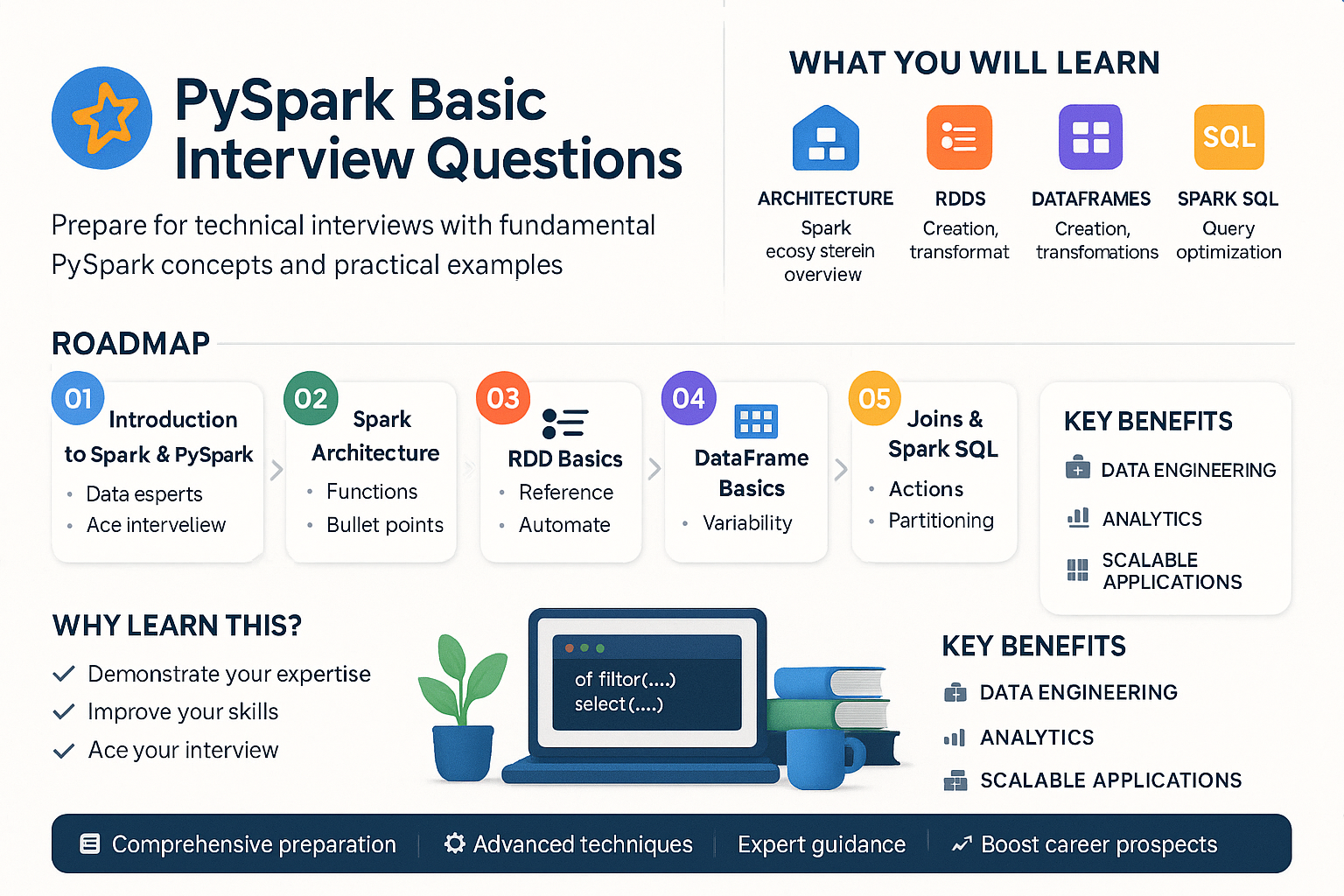
What You'll Learn
- Here are key topics to cover in your PySpark Interview Questions course:
- PySpark Architecture and Spark Ecosystem Overview
- RDDs: Creation, Transformations, and Actions
- DataFrame Creation, Transformations, and Actions
- DataFrames vs RDDs
- SparkSession and SparkContext
- Spark SQL and Query Optimization
- Lazy Evaluation and DAG Execution
- Narrow vs Wide Transformations
- Partitioning and Repartitioning
- Joins (Broadcast, Shuffle, Sort-Merge)
- Caching and Persistence Strategies
- Working with Structured Streaming
- PySpark Best Practices and Common Interview Scenarios
Introduction to Spark & PySpark
- What is Apache Spark and how does it differ from Hadoop?
- What are the key components of PySpark and how do they contribute to data processing?
- Explain the difference between an RDD and a DataFrame in PySpark.
- How does PySpark handle transformations and actions on data, and why is this distinction important?
- What is the purpose of partitioning in PySpark, and how can it impact performance?
- Explain caching in PySpark and its role in improving performance.
- How does PySpark's Catalyst Optimizer improve the performance of SQL queries?
- Describe how PySpark can be integrated with other big data tools and why this is beneficial.
- What are some common performance issues in PySpark applications, and how can they be mitigated?
- What role does SparkSession play in PySpark applications, and how do you initialize it?
Spark Architecture
- Can you explain the architecture of a PySpark application? Specifically, describe the roles of the Driver, Executors, and Cluster Manager.
- What is the difference between transformations and actions in PySpark, and why is the distinction important?
- How does lazy evaluation in PySpark help in optimizing pipeline performance?
- What role does the Spark Driver play in application execution and how does it ensure efficient job scheduling in PySpark?
- How does Spark handle data shuffling, and what are its implications on PySpark application performance?
- Explain the concept of RDD lineage in PySpark and its significance for fault tolerance.
- Discuss the advantages and considerations when using the Spark YARN Cluster Manager.
- What are Spark Executors and how do they contribute to the overall performance of a PySpark application?
- Why is partitioning important in PySpark, and how does it impact performance in distributed data processing?
RDD Basics
- What is an RDD and how does it relate to transformations and actions in PySpark?
- Describe how lazy evaluation works in RDDs and why it is beneficial.
- How does the flatMap() transformation differ from map() in PySpark RDDs, and when would you use each?
- Explain the significance of partitioning in RDDs. How can you optimize performance by partitioning data?
- Can you explain the difference between narrow and wide transformations in RDDs with examples?
- What is the role of SparkContext in RDD operations and how does it manage RDD lifecycle?
- How can you persist RDDs to improve performance in PySpark applications?
- How does the reduce() action differ from reduceByKey() transformation in PySpark RDDs?
- What strategies can you use to optimize the performance of PySpark RDD operations?
DataFrame Basics
- How do you create a DataFrame in PySpark and why might you choose to use a DataFrame over an RDD?
- What are the advantages of using Spark SQL to manipulate DataFrames in PySpark?
- How can you read data from a CSV file into a PySpark DataFrame, and what options are important to consider while doing so?
- How do you filter rows in a DataFrame using PySpark?
- What are the differences between actions and transformations in PySpark, and how do they relate to DataFrames?
- How do you perform a join operation on two DataFrames in PySpark?
- Explain how to write a PySpark DataFrame to a Parquet file and its advantages over other formats.
- How does caching DataFrames work in PySpark, and when should you use it?
- What is partitioning in PySpark DataFrames and how does it impact performance?
- Describe how you would convert a PySpark DataFrame to a Pandas DataFrame and discuss when it is appropriate to do so.
Data Handling & Operations
- What is the difference between RDDs and DataFrames in PySpark, and when would you use one over the other?
- How does schema management work in PySpark when working with DataFrames, and why is it important?
- Explain how filtering operations work in PySpark DataFrames and provide an example.
- Describe how PySpark handles missing data in DataFrames and what functions are available to manage it.
- How can you perform aggregation operations on a PySpark DataFrame, and what are some common aggregation functions?
- What is Spark SQL and how can it be used to perform operations on PySpark DataFrames?
- How do you perform sorting operations in a PySpark DataFrame, and how does it differ from RDD sorting?
- What is data partitioning in PySpark, and why is it important for performance optimization?
- What are transformations and actions in PySpark, how are they different, and give examples of each?
Joins & Spark SQL
- What are the key differences between `DataFrame` joins and SQL joins in PySpark?
- How do you perform a left join between two DataFrames in PySpark, and what is its significance?
- What are some common performance considerations when performing joins in PySpark?
- Explain how broadcasting improves the efficiency of joins in PySpark. Provide an example where this might be used.
- Discuss the concept of bucketing in PySpark and how it can be used to optimize join operations.
- How can partitioning strategies affect join operations in PySpark, and what are some best practices?
- Can you perform a self-join in PySpark? Provide an example and explain its use case.
- What is the significance of using `distinct()` in join operations in PySpark?
- How does PySpark handle NULL values during join operations, and what impact do they have?
- Explain how PySpark supports SQL query execution and the integration between Spark SQL and the DataFrame API.
File Formats & Persistence
- What are the supported file formats in PySpark and how do you read data from these formats?
- How can you write DataFrames to different file formats in PySpark, and what are some common options you can specify?
- Explain caching in PySpark and how it can improve performance. What are the differences between `cache()` and `persist()`?
- What is partitioning in PySpark, and why is it important for performance tuning?
- Describe how you can combine file formats and partition strategies in PySpark for an optimal data pipeline.
- How might you handle writing data to different file formats if there are schema changes over time?
- What is the impact of incorrect partition size, and how can you determine the optimal partition size in a PySpark application?
- How does partition pruning improve query performance, and what are the necessary conditions for it to work effectively in PySpark?
- What best practices would you recommend for managing file sizes and partition keys when writing large scale datasets in PySpark?