AIStudyLabs
Learn Kotlin by Questions
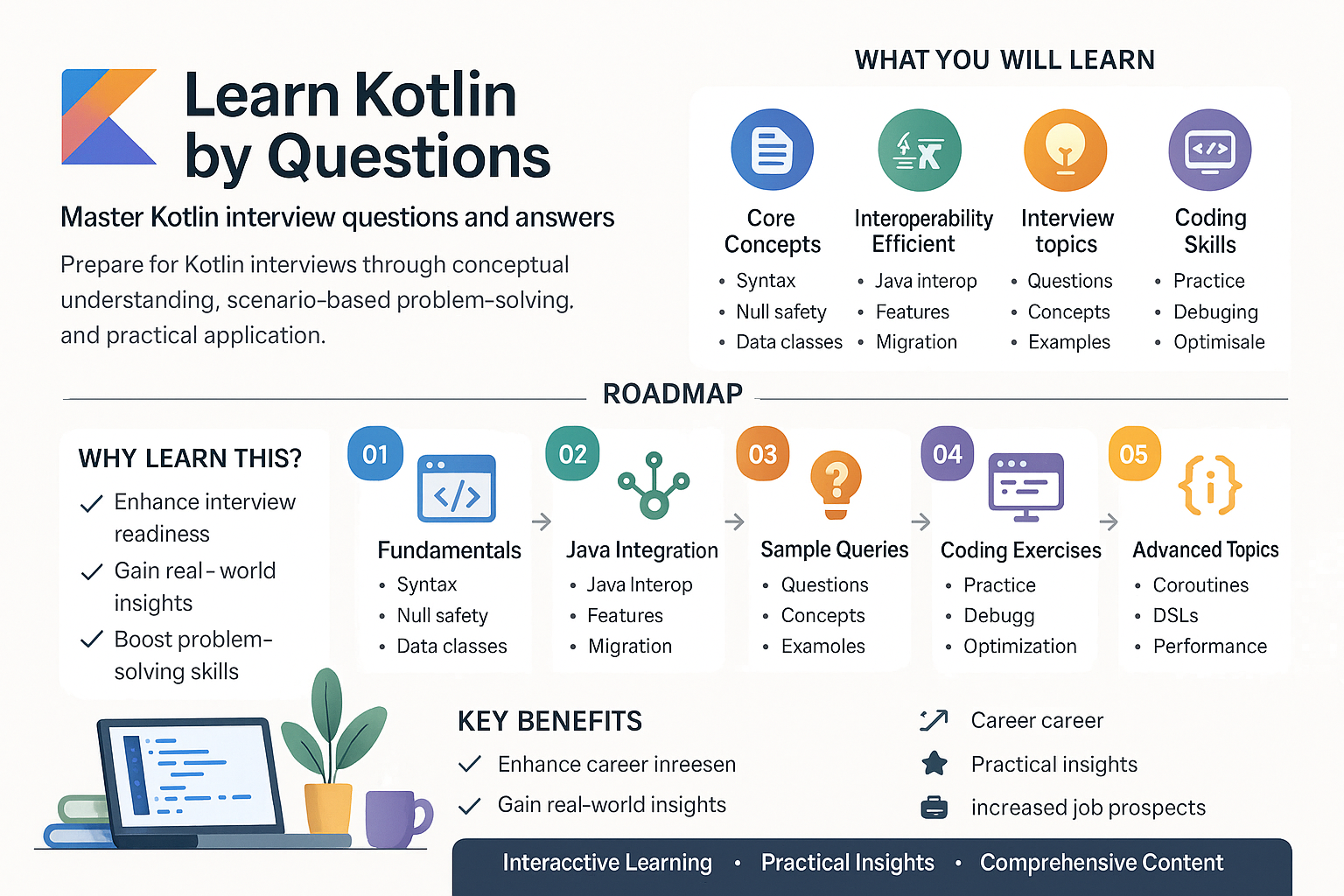
The Kotlin Interview Questions course is meticulously designed to equip learners with the essential skills needed to excel in Kotlin-related technical interviews. This course delves into a wide array of questions that encompass conceptual understanding, scenario-based problem-solving, and practical application of Kotlin programming. Participants will navigate through a curated selection of interview questions and answers that cover fundamental to advanced Kotlin concepts, ensuring they are well-prepared for any interview challenge.
By focusing on real-world interview preparation techniques utilized by leading technology companies, this course provides invaluable insights into the expectations of tech interviewers. Learners will gain confidence in articulating their knowledge, solving complex problems, and demonstrating their proficiency in Kotlin, thereby enhancing their chances of success in technical interviews.
What You'll Learn
- Understand the core principles and features of Kotlin programming.
- Explain Kotlin's interoperability with Java and its implications in development.
- Analyze common conceptual questions asked in Kotlin interviews.
- Evaluate scenario-based questions to apply Kotlin solutions effectively.
- Solve practical coding problems using Kotlin in realistic interview settings.
- Identify and articulate solutions to advanced Kotlin programming challenges.
- Apply Kotlin's functional programming features in problem-solving scenarios.
- Compare Kotlin's features with other programming languages during interviews.
- Develop strategies for answering tricky Kotlin interview questions confidently.
- Demonstrate proficiency in Kotlin by completing real-world coding tasks.
- Interpret technical interview questions to determine the best Kotlin approaches.
- Articulate the benefits and use cases of Kotlin in modern software development.
Kotlin Basics
- What are the main differences between Kotlin and Java?
- Explain the concept of null safety in Kotlin. How does Kotlin handle null values?
- Can you detail the 'when' expression in Kotlin? How is it more powerful than Java's switch statement?
- How does Kotlin handle immutability? Explain the difference between 'val' and 'var'.
- What are extension functions in Kotlin and how are they useful?
- Discuss the use of data classes in Kotlin and how they differ from regular classes.
- What is type inference in Kotlin and how does it improve code quality?
- How do 'sealed classes' work in Kotlin and where would you use them?
- Explain higher-order functions in Kotlin. How do they differ from regular functions?
- Discuss the 'lazy' keyword in Kotlin and its potential benefits in software development.
- How does Kotlin handle exceptions, and what are the key differences compared to Java?
- What are object expressions and declarations in Kotlin, and how do they differ?
- What are inline functions in Kotlin, and why are they important?
- How does Kotlin manage concurrency compared to Java, and what's the role of coroutines?
- What is the purpose of the 'companion object' in Kotlin, and how is it used?
- What are Kotlin scripts and how can they be useful in development workflow?
- How do delegated properties work in Kotlin and what common use cases do they have?
Object-Oriented Programming in Kotlin
- What are the fundamental principles of Object-Oriented Programming (OOP) in Kotlin?
- How does Kotlin handle single and multiple inheritance? Use examples to illustrate your answer.
- Explain the concept of data classes in Kotlin and their significance.
- How does Kotlin implement encapsulation and what are its access modifiers? Provide examples.
- What role do constructors play in Kotlin, and how are primary and secondary constructors different?
- Explain how inheritance works in Kotlin with an example of class hierarchy.
- Describe the concept of polymorphism in Kotlin with an example.
- How does Kotlin's implementation of interfaces differ from Java, and what advantages does it offer?
- What is the role of the `sealed` class in Kotlin, and when would you use it?
- How do you implement delegation in Kotlin and what are the benefits of using it?
- Describe object expressions and declarations in Kotlin and their use cases.
- What are extension functions in Kotlin, and how can they be utilized?
- Explain the concept of companion objects in Kotlin and their common use cases.
- How does Kotlin address null safety, particularly in terms of class design and type system?
- Explain what abstract classes are in Kotlin and provide an example of their use.
Functional Programming in Kotlin
- What is a lambda expression in Kotlin, and how do you use it?
- Explain higher-order functions in Kotlin and give an example of their usage.
- What is immutability, and why is it important in functional programming with Kotlin?
- How do extension functions work in Kotlin, and what purposes do they serve in functional programming?
- What are data classes in Kotlin, and why are they useful in functional programming?
- Can you explain what sealed classes are in Kotlin and when you might use them?
- How do the `let`, `run`, `with`, `apply`, and `also` functions in Kotlin work, and when would you use each?
- Explain Kotlin's standard library function `flatMap`. How does it differ from `map`?
- What are inline functions in Kotlin, and why would you use them?
- How does Kotlin enable lazy evaluation, and what are the benefits of using it?
- Describe the concept of 'scope functions' in Kotlin and their typical use cases.
- What is destructuring declarations in Kotlin, and where is it useful?
- How does functional programming in Kotlin blur the lines between 'functions' and 'objects'?
- Can you elaborate on `tail-recursive` functions in Kotlin and their use cases?
- How are closures implemented in Kotlin, and how do they benefit functional programming?
- What is the difference between `==` and `===` operators in Kotlin?
- What is the role of coroutines in Kotlin, and how are they applied in functional programming?
Kotlin Coroutines and Asynchronous Programming
- What are Kotlin coroutines and why are they important for asynchronous programming?
- How do you create and launch a coroutine in Kotlin?
- What is a coroutine context and how do you specify it?
- Can you describe structured concurrency in Kotlin and its benefits?
- Explain the difference between `launch` and `async` in Kotlin coroutines.
- What is `suspend` function in Kotlin coroutines and how does it differ from a regular function?
- Describe how to handle exceptions in Kotlin coroutines.
- How does the `Job` handle coroutines and what are the functions you can use with it?
- What is the `await()` function and in what scenario would you use it?
- What role does the `runBlocking` builder play in Kotlin coroutines?
- Explain the importance of CoroutineScope and the difference between GlobalScope and custom scopes.
- What is a `Deferred` in Kotlin and how does it affect coroutine lifecycle?
- How do you implement a coroutineScope that waits for the completion of its child coroutines?
- Describe how to use `withContext` for changing coroutine context for a specific block of code.
- How can you use coroutines to handle events in real-time applications?
- What is the difference between `Dispatcher.Main`, `Dispatcher.IO`, and `Dispatcher.Default` in Kotlin coroutines?
- How can `Flow` in Kotlin coroutines simplify working with asynchronous data streams?
Kotlin DSL (Domain Specific Language)
- What is a Domain Specific Language (DSL) and how is it implemented in Kotlin?
- Explain how the builder pattern is applied in Kotlin DSLs and its advantages.
- What are Kotlin’s function types and how do they contribute to DSL creation?
- How do extension functions aid in creating Kotlin DSLs?
- What role do lambdas play in enhancing Kotlin DSLs?
- Why is the 'with' function valuable in Kotlin when creating DSLs?
- How does Kotlin's type safety benefit DSLs?
- What is infix notation in Kotlin, and how does it enhance DSL readability?
- How can scoped functions like 'let', 'run', 'apply', and 'also' be utilized in Kotlin DSLs?
- Discuss Kotlin's ability to create typesafe builders and its impact on DSL design.
- Explain the use of reified types in Kotlin and their applicability in DSL development.
- How does Kotlin's interoperability with Java enhance the creation and usage of DSLs?
- What are lambdas with receivers, and how do they assist in DSL creation?
- How does the 'receiver object' mechanism in Kotlin facilitate DSL structures?
- What are inline functions, and why are they significant in DSLs?
- How does Kotlin's null-safety feature influence DSL design?
- What is Kotlin's 'apply' function, and how is it used in DSL contexts?
Collections and Generics in Kotlin
- What are the main differences between mutable and immutable collections in Kotlin?
- How can you filter elements in a collection using Kotlin?
- Explain the concept of generics in Kotlin. Why are they useful?
- What is a data class in Kotlin and how does it benefit collections handling?
- How can you merge two maps in Kotlin, and what are the different ways to resolve key collisions?
- Describe the differences between `map` and `flatMap` operations on collections in Kotlin.
- How do you ensure type safety in collections when using generics in Kotlin?
- How would you implement a custom comparator to sort a collection of data classes in Kotlin?
- How does Kotlin handle nullability for generic collections, and what strategy should you use to deal with it?
- What are type projections in Kotlin generics, and how do they facilitate the flexibility of collections?
- Explain how you would use sequences in Kotlin and when it's preferable over collections.
- How can extension functions enhance the capability of Kotlin collections and provide an example?
- Describe the benefits and use cases of using `groupBy` operation in Kotlin collections.
- What is the `associateBy` function in Kotlin and how does it differ from `groupBy`?
- Explain variance in Kotlin generics and its significance in collections.
- How can Kotlin's `let`, `run`, `also`, `apply`, and `with` functions simplify handling collections?
- Why would you use `partition` on a collection in Kotlin, and how does it work?
- How would you differentiate between `hashMapOf`, `linkedMapOf`, and `sortedMapOf` in Kotlin?
- What strategies can you apply to prevent errors when inserting elements in a generic collection in Kotlin?
- How would you convert a map’s keys or values into a separate collection efficiently in Kotlin?
- What is the purpose of the `fold` function in Kotlin collections, and how does it differ from `reduce`?
- How can you remove duplicates from a collection in Kotlin efficiently?
- How does Kotlin ensure immutability of collections, and what benefits does it offer for multithreaded programming?
Error Handling and Exceptions in Kotlin
- What is the purpose of try-catch blocks in Kotlin, and how do they differ from try-catch blocks in Java?
- Explain how you can create custom exceptions in Kotlin and when you would use them.
- Can you explain what an unchecked exception is in Kotlin and how it affects exception handling?
- Discuss the `finally` block in Kotlin. When would you use it, and how does it differ from `catch`?
- Explain what Kotlin's `return@label` function is and how it is used in exception handling.
- How does the `throw` expression work in Kotlin, and in what scenarios would you choose to use `throw` over returning null or an optional type?
- In Kotlin, how can you rethrow an exception, and why would you choose to do so?
- What are the benefits and use cases of Kotlin runCatching and how does it relate to conventional try-catch?
Kotlin for Android Development
- What are the primary differences between Kotlin and Java, specifically in the context of Android development?
- How do you handle asynchronous operations in Kotlin for Android development, and why are Kotlin coroutines preferred over traditional AsyncTask?
- What role do extension functions play in Kotlin for Android development, and how can they enhance the functionality of existing classes?
- Explain the usage and benefits of data classes in Kotlin, particularly in Android application development.
- What are sealed classes in Kotlin and how do they contribute to effective state management in an Android application?
- How does Kotlin facilitate functional programming principles in Android development, and what advantages does this offer?
- Describe the significance of the ViewModel and LiveData architecture components in managing UI-related data in Kotlin for Android applications.
- In an Android application using Kotlin, how would you handle dependency injection and what are the advantages of using Koin over Dagger?
- How does Kotlin's null safety feature help prevent null pointer exceptions in Android applications, and what are some best practices?
- What is the primary purpose of companion objects in Kotlin, and how do they differ from static methods in Java?
- How does Kotlin's Type Inference system work, and what benefits does it offer in Android development?
- Why is Kotlin's val and var distinction important in Android development, and how should you decide which to use?
- How does Kotlin's coroutine support enhance concurrency in Android applications compared to Java's traditional threading model?
- How do inline functions work in Kotlin and why might they be beneficial in an Android context?
Kotlin Test-Driven Development (TDD)
- What is Test-Driven Development (TDD) and how does it apply to Kotlin programming?
- How would you set up a basic testing environment in a Kotlin project?
- Explain the role of the Red-Green-Refactor cycle in TDD and its application in Kotlin.
- How does the concept of null safety in Kotlin benefit the application of TDD?
- Describe how to use mocking in Kotlin with a sample use case using Mockito.
- What are some best practices for writing effective test cases in Kotlin using TDD?
- How do you implement dependency injection in a Kotlin project and why is it important for TDD?
- How can you handle asynchronous testing in Kotlin using TDD, and what are the potential pitfalls?
- What are some common challenges when integrating TDD in Kotlin projects and how can they be mitigated?
- Can you demonstrate an example of parameterized tests in Kotlin, and explain their benefits in TDD?
- What is the difference between unit tests and integration tests in the context of Kotlin TDD?
- How does Kotlin's data class simplify testing in TDD and what are its limitations?
- How does the use of Kotlin coroutines impact the testing strategies in TDD, and what are the best practices?
Advanced Kotlin Features
- What is reflection in Kotlin and how is it different from Java's reflection?
- Explain Kotlin's delegation mechanism with an example.
- What are inline functions in Kotlin and when should you use them?
- How do you use the `lateinit` modifier and what are its limitations?
- Describe how coroutines can enhance asynchronous programming in Kotlin.
- Can you explain destructuring declarations in Kotlin with an example?
- How does Kotlin handle null safety, and what operators are used to facilitate it?
- What advantages do data classes provide in Kotlin, and how do you use them?
- What is the purpose of Kotlin extensions, and how do you implement them?
- Discuss the use of sealed classes in Kotlin and when they should be preferred over enums.
- How does Kotlin's type system differ from Java's, and what are its advantages?
- What is the role of the `companion object` in Kotlin, and how does it differ from static members in Java?
Kotlin Interoperability with Java
- What is Kotlin interoperability, and why is it important when integrating Kotlin with Java?
- How do you call Java static methods in Kotlin?
- Explain how Kotlin and Java handle nullability and how they interoperate in this aspect?
- How does Kotlin handle Java getter and setter methods, and how does it impact interoperability?
- Can you directly use Kotlin extension functions on Java classes? Provide an example.
- Describe how Kotlin type aliases can aid interoperability with Java libraries.
- How does Kotlin handle Java's checked exceptions in its interoperability?
- How does Kotlin use @JvmOverloads to handle Java method overloading?
- How can Kotlin annotations improve Java interoperability?
- Can Kotlin data classes be used seamlessly in Java, and how would you expose them appropriately?
Kotlin Best Practices and Coding Standards
- What are Kotlin's primary coding conventions, and why are they important?
- How do Kotlin's null safety features help improve code quality and what best practices can ensure their effectiveness?
- Explain the concept of Extension Functions in Kotlin and how they contribute to a better coding practice.
- What is 'smart casting' in Kotlin, and how does it enhance code efficiency?
- How does Kotlin handle immutability, and why is it considered a best practice?
- Discuss how Kotlin's data classes improve code quality and efficiency. Provide an example.
- How does Kotlin's sealed classes feature contribute to more readable and maintainable code?
- What are coroutines in Kotlin, and how do they contribute to better performance in modern applications?
- How do `companion objects` in Kotlin differ from static methods and fields in Java, and why is this approach beneficial?
- Describe Kotlin's approach to inline functions and how they contribute to performance improvements.
Kotlin Design Patterns
- How do you implement a Singleton pattern in Kotlin and what are the typical use cases for it?
- What are the primary differences between a Factory pattern and an Abstract Factory pattern in Kotlin?
- Demonstrate how the Observer pattern can be implemented in Kotlin, and explain its significance.
- Explain how Kotlin's delegation can be used to simplify the Observer pattern implementation.
- Describe how Lazy initialization can enhance the Singleton pattern in Kotlin.
- How is the Builder pattern implemented in Kotlin, and when should it be used?
- Can you explain the concept of 'object delegation' in Kotlin, and how it can simplify implementing design patterns?
- How would you optimize an Observer pattern implementation for scalability in a large Kotlin project?
- Illustrate the Command pattern implementation in Kotlin and its primary use cases.
- How can the Strategy pattern be effectively used in Kotlin, and what are the potential benefits?
- What is the Adapter pattern in Kotlin, and how can it be applied to real-world problems?
- Demonstrate how Kotlin's data classes can simplify the implementation of the Prototype pattern.
- Can you discuss how the Decorator pattern can be implemented in Kotlin, with an example?
- How would you implement a Chain of Responsibility pattern in Kotlin for handling requests in order?
- Can you explain how the State pattern can be implemented in Kotlin to manage object state changes?
- Illustrate the Facade pattern in Kotlin and discuss its usage in simplifying system interactions.
- How would you apply the Memento pattern in Kotlin to support undo mechanisms?
- What approach would you take to implement the Bridge pattern in Kotlin, and what is the rationale behind its use?
- Explain with an example how Kotlin's sealed classes can be used to implement the Visitor pattern.
- How does the Flyweight pattern optimize resource usage in Kotlin applications?
- Can you show how the Interpreter pattern can be incorporated into Kotlin for language processing?
- Discuss how Kotlin's functional capabilities support the implementation of the Composite pattern.
- What benefits does the Template Method pattern offer, and how would you implement it in Kotlin?
- Describe how Chain of Responsibility pattern can be integrated with coroutines in Kotlin for asynchronous processing.
- How could the abstract factory pattern be utilized in Kotlin to produce different families of related objects?
Kotlin Performance Optimization
- What are some common techniques used in Kotlin to optimize performance in code execution?
- How does Kotlin handle memory management, and what role does garbage collection play in its performance optimization?
- Why is the use of inline functions favored in scenarios where performance optimization is critical in Kotlin?
- Explain how lazy initialization can be utilized in Kotlin to improve performance and give an example scenario where it’s beneficial.
- What is tail recursion in Kotlin, and how does its usage improve performance in recursive solutions?
- How can the use of Kotlin’s coroutine framework enhance performance, especially in I/O-bound applications?
- Discuss how object pooling can be implemented in Kotlin to optimize performance in high-throughput applications.
- What are smart casts in Kotlin, and how can they contribute to performance optimization?
- Explain how the use of Kotlin's immutable data structures helps in optimizing memory usage and performance.
Kotlin Community and Ecosystem
- What are the primary differences between Kotlin and Java, and why might a developer choose Kotlin over Java?
- What is a data class in Kotlin and how is it different from a regular class?
- Explain Kotlin's type inference and how it compares to Java's typing system.
- How does Kotlin handle null safety differently from Java?
- What are Kotlin coroutines and how do they improve concurrency handling compared to traditional threading techniques?
- Explain the concept of extension functions in Kotlin. How do they differ from utility methods in Java?
- What are sealed classes in Kotlin, and how are they typically used?
- Describe the primary features of the Kotlin standard library that make it powerful for developers.
- How does Kotlin's "smart casting" work, and how does it improve type safety and code readability?
- What is Kotlin's "when" expression, and how does it extend beyond Java's switch statement?
- Discuss Kotlin’s companion objects and how they differ from Java’s static members.
- What role do higher-order functions and lambdas play in Kotlin? Provide a practical example.
- How does Kotlin achieve interoperability with Java code? Provide examples of how Kotlin and Java can be used together in a project.
- Explain the concept of 'data classes' in Kotlin and why they are preferable to regular classes for certain use-cases.
- How does Kotlin's 'lazy' property delegate work, and when would you use it?