AIStudyLabs
Advanced SQL Interview Questions
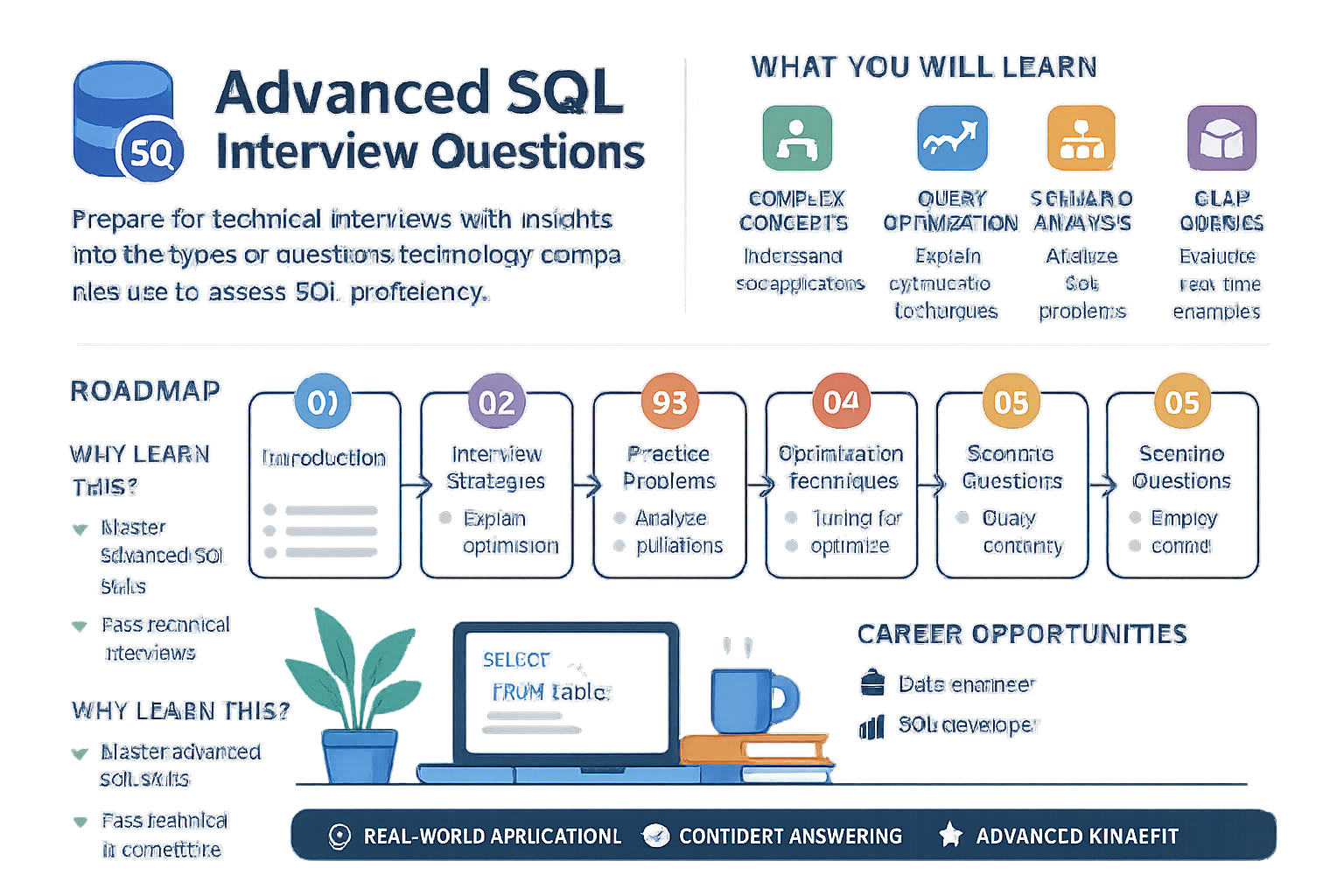
The Advanced SQL Interview Questions course is designed for those aiming to excel in data engineering interviews. This course covers a range of interview questions, including conceptual, scenario-based, and practical queries, to ensure thorough preparation. By focusing on real-world problems, learners will develop the ability to articulate complex SQL concepts clearly, solve challenging problems, and answer confidently.
Prepare for technical interviews with insights into the types of questions technology companies use to assess SQL proficiency. With a strong emphasis on real-world application, this course will help learners master the skills necessary to succeed in competitive advanced SQL interviews.
What You'll Learn
- Understand complex SQL concepts and their applications in real-world scenarios.
- Explain SQL query optimization techniques and their importance.
- Analyze scenario-based SQL problems and devise effective solutions.
- Evaluate different SQL approaches to solve data engineering challenges.
- Explain OLAP Queries with realtime examples
- Solve advanced SQL queries with confidence and accuracy.
- Apply SQL best practices to practical interview questions.
- Identify common SQL pitfalls and learn strategies to avoid them.
- Compare various SQL functions and their use cases in data manipulation.
- Demonstrate proficiency in writing efficient and scalable SQL code.
- Develop strategies for confidently answering SQL interview questions.
- Interpret complex data requirements and translate them into SQL queries.
- Prepare for SQL interviews with insights from real-world technology companies.
Advanced SQL Query Optimization
- What is the purpose of indexing, and how can it affect query performance in SQL databases?
- Explain the concept of query execution plans and how they can be used to optimize SQL queries.
- What are partitioning and sharding in SQL databases, and how do they contribute to query performance optimization?
- Describe how the use of Materialized Views can help optimize query performance in a database system.
- How can query rewriting and the use of alternative SQL constructs improve query performance?
- What are CTEs (Common Table Expressions), and how do they aid in query performance and readability?
- How does normalization affect SQL queries, and what role does denormalization play in query performance optimization?
- Explain the use and advantages of the `EXISTS` clause vs. the `IN` clause in SQL, focusing on performance differences.
- What is query plan caching and how does it boost SQL performance
- How do database locks and transaction isolation levels affect SQL query performance?
Database Design and Normalization
- Explain the purpose of normalization in database design. What are the benefits and potential drawbacks of normalizing a database?
- Define the First Normal Form (1NF) and provide an example of a table not in 1NF and how to convert it into 1NF.
- What is the Second Normal Form (2NF), and how does it differ from 1NF? Provide an example showing a table in 1NF but not in 2NF and how to convert it to 2NF.
- Explain what Third Normal Form (3NF) is and provide an example of a table in 2NF but not 3NF. How would you convert it to comply with 3NF?
- What is Boyce-Codd Normal Form (BCNF), and how does it enhance 3NF? Provide an example to illustrate a table in 3NF that violates BCNF.
- What are functional dependencies in a database, and why are they important for normalization? Provide an example to illustrate your explanation.
- Identify a scenario where denormalization might be more beneficial than normalization in a database design. What are the potential trade-offs?
- How can indexing influence the normalization and denormalization strategies in a database? Provide examples of when each might be useful.
- Describe how foreign key constraints play a role in a normalized database design and their impact on data integrity.
Advanced Joins and Subqueries
- Explain the difference between an INNER JOIN and a LEFT JOIN in SQL. Provide examples of when to use each.
- Describe how correlated subqueries differ from non-correlated subqueries, with examples.
- What is a SELF JOIN in SQL? Provide a practical example of its use case.
- How can you implement a Full Outer Join in SQL using other types of joins?
- What are window functions, and how do they differ from GROUP BY aggregates? Give a practical example.
- Explain the concept of CTEs (Common Table Expressions) in SQL. How do they differ from temporary tables?
- What is a CROSS JOIN, and in what scenarios would you use it? Give an example.
- How would you use window functions to compute a rolling average in SQL?
- Describe the use of the `EXISTS` clause in SQL with an example.
Window Functions and CTEs
- What are window functions in SQL, and how do they differ from aggregate functions? Provide an example to illustrate your point.
- How does the PARTITION BY clause in a window function affect the calculation of its result? Can you provide an example where this clause is employed?
- What is a Common Table Expression (CTE) in SQL, and how does it facilitate complex query construction? Provide a use case illustrating its benefits.
- Describe the differences between RANK(), DENSE_RANK(), and ROW_NUMBER() window functions. Provide examples to highlight their differences.
- Explain how window functions combined with CTEs can be used to solve complex queries, such as finding the top N entries per category. Provide a concise use case.
- Can window functions be used with JOINs in SQL? Illustrate with an example how this is done and why it might be useful.
- What are the performance considerations when using window functions in SQL? How can you optimize these queries in practice?
- How can you implement a moving average using window functions in SQL? Why is this useful in time-series data analysis?
- What is the significance of the ORDER BY clause within window functions? Explain with an example why or when you would choose a specific order.
SQL Transactions and Concurrency Control
- What is a transaction in SQL, and why is it important?
- Can you explain the concept of isolation levels in SQL and the implications of choosing different levels?
- How do deadlocks occur in SQL, and how might you prevent them?
- What are some best practices for optimizing concurrency in SQL databases?
- Describe the role and challenges of handling phantom reads in SQL.
- How does SQL Server's Read Committed Snapshot Isolation (RCSI) differ from traditional Read Committed Isolation?
- What methods can be used to detect and resolve deadlocks in a SQL environment?
- Discuss the pros and cons of using optimistic versus pessimistic concurrency control in SQL databases.
- What is a dirty read, and how can you prevent it in a transactional database system?
Data Warehousing Concepts
- What is dimensional modeling in the context of data warehousing, and why is it used?
- How does SQL support ETL (Extract, Transform, Load) processes in data warehousing?
- Explain the purpose of the star schema in a data warehouse, and how does it differ from a snowflake schema?
- Can you explain the concept of slowly changing dimensions (SCD) and how they are managed in a data warehouse?
- What role does indexing play in a data warehouse, and how can it improve query performance?
- Describe how partitioning works in a data warehouse and its effect on performance and management.
- How can you ensure data integrity in a data warehouse while handling ETL processes?
- What are the challenges faced in data warehousing related to SQL queries, and how can they be mitigated?
- Discuss how data warehouse-specific optimization techniques differ from those used in transactional databases.
Dynamic SQL and Stored Procedures
- What is dynamic SQL, and how does it differ from static SQL?
- Explain how to prevent SQL injection attacks when using dynamic SQL.
- Describe the benefits and potential drawbacks of using stored procedures in SQL databases.
- How can you execute a stored procedure within a dynamic SQL statement?
- What are the differences between a stored procedure and a function in SQL databases?
- What role do temporary tables play within dynamic SQL execution in stored procedures?
- How does execution context affect dynamic SQL inside stored procedures?
- What are the potential performance implications of using dynamic SQL in stored procedures?
- What strategies can you use to debug errors in dynamic SQL within stored procedures?
- How do you decide when to use dynamic SQL versus static SQL within a database application?
SQL Performance Tuning
- 1. What are SQL indexes, and how do they improve query performance?
- 2. How can execution plans be used to optimize SQL queries?
- 3. Discuss the difference between clustered and non-clustered indexes and their performance implications.
- 4. Explain the impact of JOIN operations on SQL query performance and how to optimize them.
- 5. What are the advantages of using partitioning in SQL databases, and how does it affect performance?
- 6. How does query rewriting support SQL performance optimization?
- 7. Describe how database locking mechanisms can influence SQL query performance.
- 8. How do SQL hints help with performance tuning, and when should they be used?
- 9. What role do stored procedures have in SQL performance optimization?
- 10. Explain how denormalization can improve SQL query performance, and discuss its trade-offs.
SQL Security and Permissions
- What is the principle of least privilege, and how does it apply to SQL databases?
- How can you manage roles and permissions efficiently in a large organization using SQL?
- What are the differences between GRANT and REVOKE commands in SQL?
- Explain how SQL injection could occur and best practices for preventing such vulnerabilities.
- How can you ensure database audit logs are securely managed in SQL systems?
- Describe how row-level security (RLS) operates in SQL databases.
- How can you implement effective password policies for SQL database user accounts?
- What strategies can be employed to manage and audit database user permissions effectively?
- Discuss the importance and methods of enforcing data encryption in SQL databases.
Handling Large Datasets in SQL
- How would you efficiently retrieve the top 10 records from a table of several million rows, ordered by a specific column?
- Explain the concept of partitioning in SQL databases and its importance in handling large datasets.
- When working with large datasets, how can indexes improve query performance, and what are the trade-offs?
- Describe a scenario where you would choose a clustered index over a non-clustered index for a large dataset.
- How can window functions be used to efficiently calculate rolling aggregates over large datasets?
- What strategies would you use to minimize the execution time of a query joining multiple large tables?
- Why might a query involving large datasets benefit from the use of a CTE (Common Table Expression) instead of a subquery or a temporary table?
- Describe how you could use SQL to identify and remove duplicate records from a large dataset table.
- How would you handle querying a multi-terabyte table where only a subset of data queried changes frequently?
Querying NoSQL with SQL-like Syntax
- How does SQL-like syntax work with NoSQL databases like MongoDB?
- Explain the use of indexing in NoSQL databases with SQL-like querying capabilities.
- Describe a scenario where denormalization might be preferred in a NoSQL database implementing SQL-like queries.
- Discuss how aggregations are handled in NoSQL databases and compare it with SQL.
- What are the challenges of maintaining data consistency in NoSQL databases using SQL-like syntax, and how are these challenges typically addressed?
- How do NoSQL databases implement transactions to support operations similar to those in SQL databases?
- Explain how permissions and access control are typically managed in NoSQL databases that use SQL-like syntax.
- How can schema design impact the performance and flexibility of SQL-like queries in NoSQL databases?
- Can you provide an example of how SQL-like syntax handles pagination in NoSQL databases?
- How do NoSQL databases with SQL-like syntax manage adaptive transformations of data through queries?
Error Handling in SQL
- What are the fundamental differences between error handling in SQL and traditional programming languages such as Java or Python?
- How does the TRY...CATCH block work in SQL Server, and what are its limitations?
- In PostgreSQL, what mechanisms exist for error handling within PL/pgSQL functions?
- What is the role of SQL code-based error handling mechanisms versus database management configurations (e.g., constraints, triggers)?
- How can you use the RAISERROR statement in SQL Server for custom error handling?
- Describe how Oracle manages transactions and handle exceptions with pre-existing built-in packages.
- What practical approaches can be employed to log errors in a SQL database to facilitate easier troubleshooting?
- How does MySQL implement error handling through handlers, and what are the common use cases?
- Explain the differences between logging errors directly within a database versus exporting those logs for analysis through third-party monitoring tools. Which approach is more advantageous under different conditions?
Backup and Recovery Strategies
- What are the main types of SQL backup strategies and when should each be used?
- Explain the recovery models in SQL Server and their impact on backup strategy.
- How would you restore a SQL Server database to a point-in-time using transaction log backups?
- What role does the SQL Server system database 'msdb' play in backup and recovery?
- Can you explain the significance of a tail-log backup in SQL Server?
- How would you approach optimizing backup performance in SQL Server?
- Discuss the significance of database snapshots for backup and recovery operations.
- Why is it crucial to regularly test your SQL Server disaster recovery plan, and how would you implement such a test?
- Describe the impact of transaction log truncation on backup and recovery processes in SQL Server.
Data Visualization with SQL
- How can you visualize data distribution directly within SQL using window functions?
- Explain how you would use Common Table Expressions (CTEs) to break down complex queries and enhance readability.
- How can you use the GROUP BY clause in SQL to create pivot tables for summarizing data and providing insights?
- Describe a method to optimize SQL queries for faster data retrieval, particularly in the context of large datasets.
- Can you demonstrate how to use the CASE statement in SQL to create conditional logic within a SELECT query for data categorization?
- Explain the concept of a 'rolling average' in SQL and provide an example of how it can be implemented to smooth time series data.
- How do you use SQL to visualize cumulative data series for running totals?
- In what ways can SQL be paired with data visualization tools to enhance dashboard analytics, and why is this beneficial?
- What are the advantages and considerations involved in using SQL views for data visualization tasks?
Emerging SQL Technologies and Trends
- What are window functions in SQL, and how do they differ from regular aggregate functions?
- Explain the concept of CTEs (Common Table Expressions) in SQL and when you might use them.
- Can you define normalization and explain its importance in database design?
- Describe the differences between SQL's DELETE, TRUNCATE, and DROP operations.
- What is the ROW_NUMBER() function in SQL and how does it differ from RANK() and DENSE_RANK()?
- What is a database index, and what are the trade-offs in using them?
- Explain the use and benefits of transactions in SQL.
- Discuss the concept of sharding in databases and how it impacts SQL operations.
- What role do constraints play in SQL databases?
- How do you handle time zone differences in SQL when dealing with global applications?