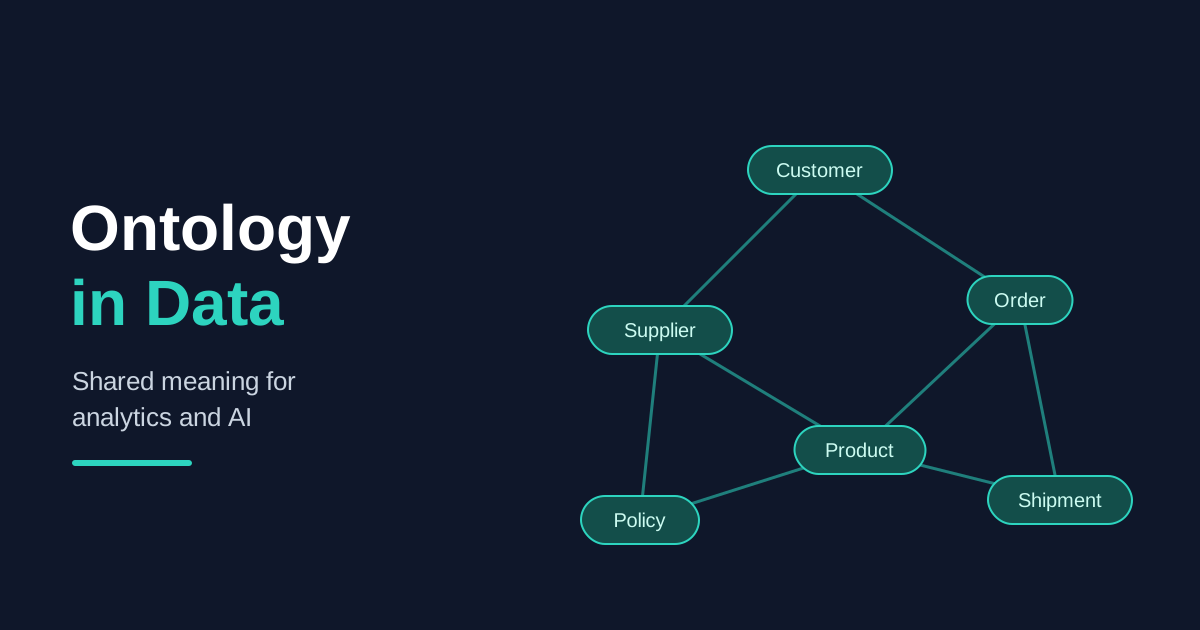
Every large company has a quiet problem that shows why an ontology in data matters. Say sales reports 120,000 customers, finance reports 95,000 and support reports 140,000.
Nobody is lying. Each system just means something different by "customer". One counts anyone with an account, one counts people who paid in the last twelve months, and one counts every email address that ever opened a ticket.
With AI in the picture, that old annoyance becomes a real blocker. Ask a language model "How many active customers do we have?" and it has no way to know which definition is right, so it guesses. An ontology in data is what removes the guess: it gives your data an explicit, shared meaning that machines can read.
Below, you'll compare an ontology with a schema, a knowledge graph and a semantic layer, build a small one in Python, and see which open-source ontology tools teams use.
What Is an Ontology in Data?
The word comes from philosophy, where ontology is the study of what exists. Computer science borrowed it in the early 1990s, and Tom Gruber's widely cited definition calls an ontology "an explicit specification of a conceptualization". Put simply, an ontology in data is a formal model of a domain that states:
- What kinds of things exist (classes), such as Customer, Order, Product and Shipment.
- What characteristics they have (properties), such as a customer's signup date or an order's total.
- How they relate (relationships), such as "a Customer places an Order" and "an Order contains Products".
- What rules apply (constraints and logic), such as "every Order has exactly one Customer" or "a Premium Customer is a kind of Customer".
- Which real things belong to each concept (instances), such as Alice, order 1001 or a specific laptop.
The important word is formal. A glossary on a wiki is readable by people. An ontology is written in a precise language that people and software can both read, query and reason over, and that's what makes it useful to AI.
Ontology in Data vs. Taxonomy, Schema, Knowledge Graph and Semantic Layer
These terms get mixed up constantly, and even vendors draw the lines in slightly different places. The distinctions below are the ones most practitioners accept.
| Concept | What it captures | Example |
|---|---|---|
| Taxonomy | A hierarchy of categories, mostly "is-a" | Electronics → Computers → Laptops |
| Database schema | How data is stored: tables, columns, types, keys | orders(order_id INT, cust_id INT, amt DECIMAL) |
| Ontology | What concepts mean, how they relate and which rules govern them | "A Premium Customer is a Customer who spent over 1,000 USD in a year" |
| Knowledge graph | An ontology populated with real data as connected entities | Alice → placed → Order 1001 → contains → Laptop |
| Semantic layer | The layer that maps business meaning onto physical data for every tool | One "Active Customer" definition used by every dashboard and AI assistant |
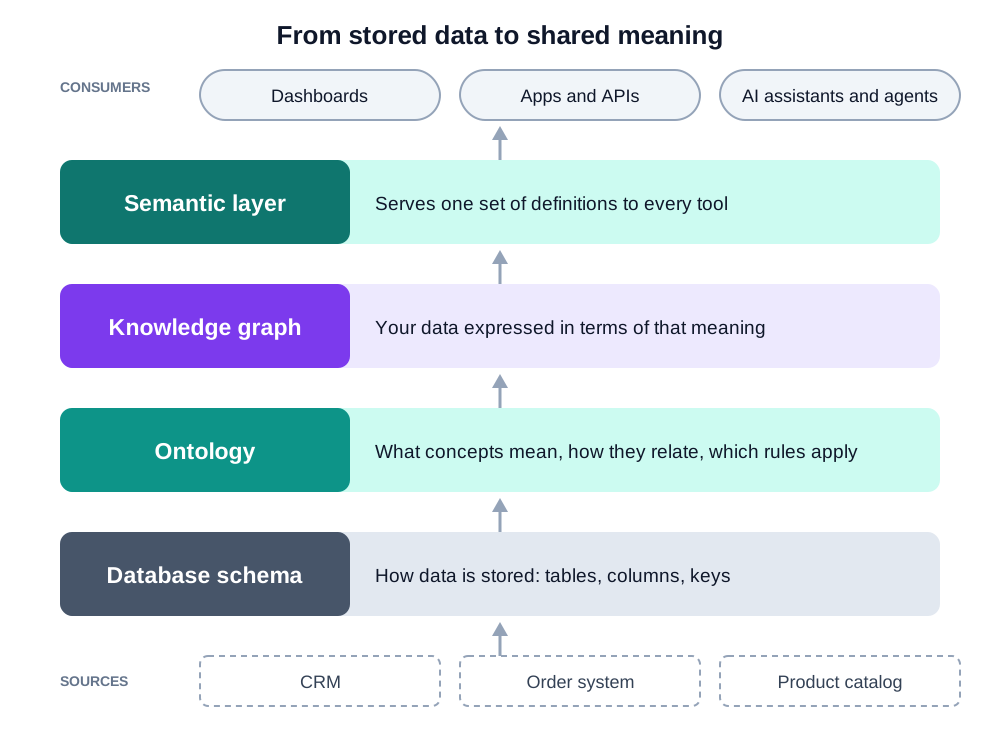
A handy way to remember it: the schema says how data is stored, the ontology says what it means, and the knowledge graph is your data expressed in terms of that meaning. The semantic layer is the plumbing that serves that meaning to every consumer. A knowledge graph built without an ontology underneath tends to end up as an expensive visualization.
Why Companies Need an Ontology in Data Systems
One definition for every business concept
The customer-count problem is the classic case. The ontology defines Customer, Active Customer and Churned Customer once, with explicit rules, and maps each source system onto them. Reports stop contradicting each other because they inherit the same meaning from the semantic layer.
Integration across silos
Large enterprises run many applications, each with its own naming habits. cust_id, client_no and account_ref may all identify the same person. Point-to-point mappings between systems grow painfully with every new system. An ontology in data acts as a hub instead: you map each system once to the shared model, and every system becomes understandable in terms of every other.
Relationships you can query
Relational databases store rows well but treat relationships as join conditions each analyst has to rediscover. Questions like "Which suppliers are two steps away from a sanctioned entity?" are natural in a knowledge graph and painful in SQL.
Governance and compliance
Regulated industries have to prove what their numbers mean. Banks report on counterparties and legal entities, and hospitals code diagnoses. An ontology gives each concept an auditable definition, which is why finance invested in FIBO, the Financial Industry Business Ontology maintained as an open standard by the EDM Council.
Inference
Because an ontology contains logic, software can derive facts nobody entered. Declare "is subsidiary of" as transitive and the system knows a sub-subsidiary belongs to the parent group, without that rule being copied into every report.
The Standards Behind Ontologies
Most open ontology work builds on a family of W3C standards. You'll see these names in every tool.
| Standard | Purpose | |---|---| | RDF | The data model: every fact is a subject, predicate and object triple | | RDFS | Basic vocabulary for classes, subclasses, domains and ranges | | OWL | Richer logic: equivalence, disjointness, cardinality, transitive and inverse properties | | SPARQL | The query language for RDF graphs | | SHACL | Validation rules, such as "every Order has exactly one customer" | | SKOS | Lightweight vocabulary for taxonomies and controlled terms |
Not every ontology uses these standards. Property graphs such as Neo4j and commercial platforms such as Palantir Foundry use their own modeling approaches, but the ideas of types, properties, relationships and rules are the same.
A Worked Example: An Online Retailer
Picture a retailer with three systems: a CRM with customer profiles and loyalty tiers, an order system, and a product catalog. The business wants to know which customers bought which products, and it wants premium customers counted as customers everywhere, without anyone writing a special case.
The ontology defines four classes (Customer, PremiumCustomer, Order, Product), says PremiumCustomer is a subclass of Customer, and defines two relationships: a Customer placed an Order, and an Order contains a Product. Data from the three systems is then written using those terms.
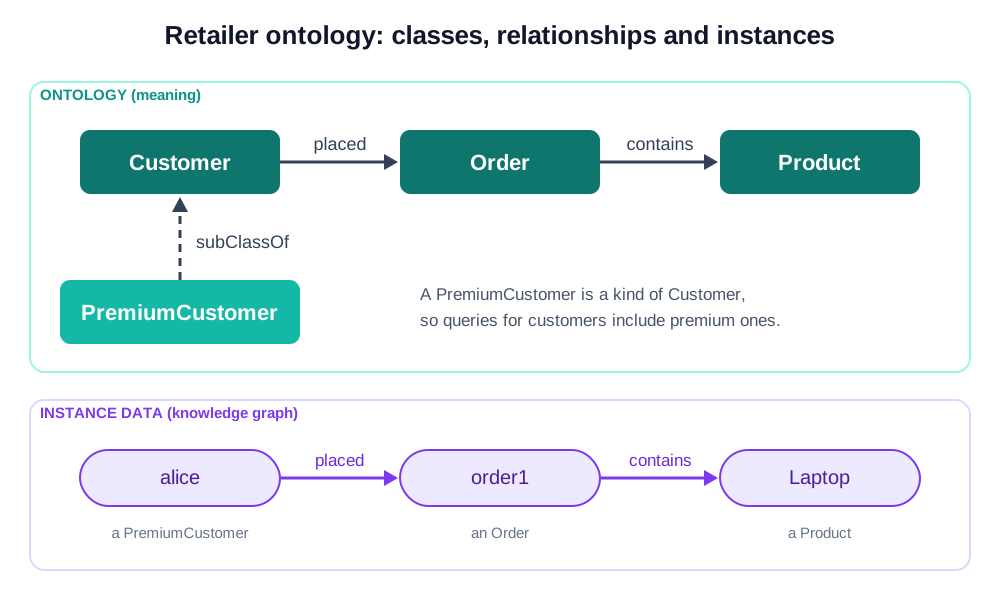
The example uses rdflib, a popular open-source Python library for RDF, the W3C data model behind most ontologies. The ontology and data are written in Turtle, a compact text format for RDF, and queried with SPARQL, using the standards from the table above.
from rdflib import Graph

ttl = """
@prefix ex:   <http://example.com/shop#> .
@prefix rdfs: <http://www.w3.org/2000/01/rdf-schema#> .
@prefix owl:  <http://www.w3.org/2002/07/owl#> .

# --- Ontology (the schema of meaning) ---
ex:Customer        a owl:Class .
ex:PremiumCustomer a owl:Class ; rdfs:subClassOf ex:Customer .
ex:Order           a owl:Class .
ex:Product         a owl:Class .

ex:placed   a owl:ObjectProperty ; rdfs:domain ex:Customer ; rdfs:range ex:Order .
ex:contains a owl:ObjectProperty ; rdfs:domain ex:Order    ; rdfs:range ex:Product .

# --- Instance data (from CRM, orders and catalog systems) ---
ex:alice a ex:PremiumCustomer ; ex:placed ex:order1 .
ex:bob   a ex:Customer        ; ex:placed ex:order2 .
ex:order1 a ex:Order ; ex:contains ex:laptop .
ex:order2 a ex:Order ; ex:contains ex:mouse .
ex:laptop a ex:Product ; rdfs:label "Laptop" .
ex:mouse  a ex:Product ; rdfs:label "Wireless Mouse" .
"""

g = Graph()
g.parse(data=ttl, format="turtle")

query = """
PREFIX ex:   <http://example.com/shop#>
PREFIX rdfs: <http://www.w3.org/2000/01/rdf-schema#>
SELECT ?customer ?product WHERE {
  ?customer a/rdfs:subClassOf* ex:Customer ;
            ex:placed/ex:contains ?item .
  ?item rdfs:label ?product .
}
ORDER BY ?customer
"""

for row in g.query(query):
    print(row.customer.split("#")[1], "->", row.product)
Output:
alice -> Laptop
bob -> Wireless Mouse
How it works:
- The first block of Turtle is the ontology. It describes meaning, not storage.
- The second block is instance data. In production you'd generate it from the CRM, order and catalog databases through mappings, which turns the whole thing into a small knowledge graph.
- Alice is stored only as a
PremiumCustomer, never as aCustomer, yet the query returns her. The patha/rdfs:subClassOf*follows the class hierarchy, so no report needs an "include premium customers" rule. - The path
ex:placed/ex:containswalks from customer to order to product in one step, with no join keys.
Add a GoldCustomer subclass next year and every query written this way picks it up. A plain ?c a ex:Customer pattern wouldn't, unless you also run a reasoner, so write hierarchy-aware queries from the start.
Open-Source Ontology Tools and Packages
You don't need a commercial platform to start. The open-source ontology tools below cover modeling, programming, storage and querying.
Modeling and editing
| Tool | Language | Used for | |---|---|---| | Protégé | Java | A widely used free, open-source ontology editor from Stanford. Visual OWL editing with plug-in reasoners | | LinkML | Python / YAML | A modeling language (Apache-2.0) whose YAML schemas compile to JSON Schema, RDF/OWL, SQL DDL and Python classes |
Programming libraries
| Library | Language | Used for | |---|---|---| | rdflib | Python | Parse, build, serialize and query RDF graphs with SPARQL | | Owlready2 | Python | Load, edit and save OWL 2 ontologies as Python objects, with the bundled HermiT reasoner (LGPL v3) | | owlrl | Python | RDFS and OWL 2 RL inference on top of rdflib | | pySHACL | Python | Validate RDF data against SHACL shapes | | OWL API | Java | A Java API for OWL 2, used inside Protégé |
Storage, query and integration
| Tool | Used for | |---|---| | Apache Jena and Fuseki | Java RDF framework with RDFS and OWL reasoners, a SHACL processor, and Fuseki as a SPARQL server | | Eclipse RDF4J | Java framework and triple store for RDF and SPARQL | | Ontop | Virtual knowledge graph: translates SPARQL to SQL over your existing databases, so nothing is copied | | Neo4j neosemantics (n10s) | Imports RDF, OWL and SKOS into Neo4j, with SHACL validation (self-hosted Neo4j only) | | Microsoft GraphRAG | Python pipeline that extracts a knowledge graph from documents with an LLM and uses it for retrieval |
Which to pick depends on where your data lives. If it's already in a relational warehouse, Ontop lets you put a semantic layer on top without moving anything. If you're prototyping in Python, rdflib plus pySHACL is enough to learn the ideas in an afternoon.
Ready-made ontologies
Building from scratch is rarely necessary. Before you model anything, check these:
- schema.org for general concepts such as Person, Organization, Product and Event.
- FIBO for financial instruments, legal entities and contracts.
- Gene Ontology and the other OBO Foundry ontologies, a shared collection for biology and medicine.
- Dublin Core and DCAT, the W3C Data Catalog Vocabulary, for documents and datasets.
How an Ontology in Data Is Used With AI
Language models are fluent, but they know nothing about your company's definitions, systems or rules. An ontology supplies exactly that context, and it shows up in five patterns.
Grounding LLM answers over enterprise data
One frequently referenced study is a 2023 benchmark by Juan Sequeda, Dean Allemang and Bryon Jacob at data.world. They asked GPT-4 business questions over an insurance database built on a standard industry data model. Querying the raw SQL tables, it answered correctly about 16.7% of the time.
Asking the same questions over a knowledge graph representation of the same database, built on an ontology, raised accuracy to about 54%. A 2024 follow-up added ontology-based checks that catch invalid queries and ask the model to repair them, which reached 72.55%.
The reason is easy to see. A table called pol_trm_cd tells a model almost nothing. An ontology that says "a Policy has a Term, and a Claim is filed against a Policy" tells it how the business works.
Better context, not more context
A common mistake is to paste the entire warehouse schema into the prompt and hope. A July 2026 AWS Database Blog post on ontologies for AI assistants makes the same point: more raw metadata doesn't reliably help, and very long contexts lead to hallucinated joins and wrong aggregations. Their design uses the ontology to fetch only the concepts a question needs, combining a graph store, a vector index for semantic search (so "customer churn" can match "attrition"), and a facts layer with confidence scores and provenance.
GraphRAG
Standard retrieval-augmented generation finds text chunks similar to a question, usually through the kind of index explained in how vector databases store and search embeddings. It struggles when the answer is spread across many documents. GraphRAG builds a knowledge graph of entities and relationships and retrieves along those links.
When the graph follows a well-designed ontology, the allowed entity and relationship types constrain what gets extracted, so quality control moves from generation time to ingestion time. In practice, graphs extracted automatically with no ontology tend to be noisier, which limits how much they help. The same retrieval trade-offs come up in these RAG architecture interview questions and model answers.
Letting AI agents act safely
Agents don't just answer. They update records, open tickets and trigger workflows, so they need to know what can be done to each thing, by whom and under which rules. Palantir's Foundry Ontology is a prominent example. Its documentation splits the ontology into semantic elements (object types, properties and link types) and kinetic elements (action types, functions and dynamic security), and defines an action type as "the schema definition of a set of changes or edits to objects, property values, and links".
The design means an agent working through that layer is limited to actions that have been defined and permissioned, rather than writing arbitrary SQL.
AI helping to build ontologies
It also works the other way round. Building an ontology traditionally meant top-down workshops with domain experts.
LLMs can now propose concepts, relationships and business terms from catalogs, schemas and documents. The AWS approach builds the ontology bottom-up from data profiles, for example spotting that a status_code column with values like "SHIP" is described by a status_description column containing "Shipped".
Microsoft's Fabric IQ includes an agent that inspects Power BI semantic models, OneLake schemas and documents to propose entities, relationships and rules. People still review what it proposes.
How Ontology-Driven Platforms Change Enterprise AI
From tables to business concepts
For decades the core unit of enterprise data was the table, and analysts had to know which of hundreds of tables held the truth. Ontology-driven platforms make business concepts the core unit: Customer, Shipment, Aircraft, Patient. Tables become details mapped underneath.
From dashboards to operations
Traditional analytics ends in a chart someone interprets. An ontology that includes actions closes the loop: a planner sees a delayed shipment and, in the same model, reassigns it, notifies the customer and updates inventory.
The big platforms are converging
- Palantir put the ontology at the center of Foundry and its AI Platform, and its documentation describes it as a digital twin of the organization in many settings.
- Microsoft introduced Fabric IQ, whose ontology models business entities, relationships, rules and actions bound to data in OneLake. It's reachable by agents through the Model Context Protocol (MCP), so agents from different vendors can share the same business context. Parts of it were still in preview during 2026.
- AWS published a reference design for ontology-backed assistants in July 2026, built around a semantic layer of graph, vector and facts stores.
- According to Neo4j, Gartner's 2025 Hype Cycle for Generative AI placed knowledge graphs on the "Slope of Enlightenment", a sign of maturing adoption.
The context layer
A newer term is the context layer: the ontology packaged with metadata, policies, metrics and provenance so agents interpret company information consistently. Underneath it sits a knowledge graph built on an ontology.
Challenges and Limitations
Ontologies earn their keep, but they aren't free.
- Agreeing on definitions forces hard conversations between departments. That's also where much of the value comes from.
- OWL and SPARQL are unfamiliar to most data engineers, though LinkML and visual editors lower the barrier.
- Modeling the whole enterprise at once usually fails. Start with one narrow, high-value domain.
- Without a clear owner, the model drifts away from changing source systems.
- Large graphs with heavy reasoning can be expensive to query, and commercial platforms cost a lot.
- Much published evidence comes from vendors. The independent research is encouraging but limited, so measure results on your own questions.
It's usually worth it when several systems disagree about the same concepts or when you want AI to answer over structured data. If you have one well-modeled warehouse and a small team, a well-documented dbt project (a SQL transformation tool) or a metrics layer may be enough for now.
Getting Started
- Pick one painful question that crosses several systems, such as churn or supplier risk.
- List the core concepts and relationships in plain language, with business owners in the room.
- Reuse before inventing: check schema.org, FIBO or an industry model.
- Model it in Protégé or LinkML, and validate data with SHACL.
- Map real data into a knowledge graph, by loading it or virtually with Ontop.
- Connect dashboards, APIs and LLM assistants, measure accuracy, then expand.
Key Takeaways
- An ontology in data is a formal, machine-readable model of what exists in a business, how things relate and which rules apply. It's the core of any semantic layer.
- Companies use it to agree on definitions, integrate silos, query relationships, satisfy regulators and infer new facts.
- Mature open-source ontology tools exist, from Protégé and rdflib to Apache Jena, Ontop and LinkML, plus reusable ontologies like schema.org and FIBO.
- For AI, a knowledge graph built on an ontology grounds LLM answers, improves accuracy on enterprise data, structures GraphRAG and lets agents act through defined, permissioned actions.
References
- Palantir, Ontology core concepts and Ontology overview
- Sequeda, Allemang and Jacob, A Benchmark to Understand the Role of Knowledge Graphs on Large Language Model's Accuracy for Question Answering on Enterprise SQL Databases (arXiv, 2023)
- Allemang and Sequeda, Increasing the LLM Accuracy for Question Answering: Ontologies to the Rescue! (arXiv, 2024)
- AWS Database Blog, Build a semantic ontology to power AI assistants on AWS, Part 1 (2026)
- Microsoft Fabric Blog, Introducing Microsoft Fabric IQ
- Gartner, First Take: Microsoft Fabric IQ
- EDM Council, Financial Industry Business Ontology (FIBO)
- Enterprise Knowledge, What Is a Semantic Layer?
- Owlready2 documentation, Apache Jena documentation, LinkML, Neo4j neosemantics
- Gruber, T. R., "A translation approach to portable ontology specifications", Knowledge Acquisition (1993)
- Microsoft Research, GraphRAG